Could they both be wrong?

The federal government can cut unnecessary spending to rebuild the storm-devastated Gulf Coast, President Bush said today, adding that he would oppose any tax increase.

Los Angeles Times

House Majority Leader Tom DeLay said yesterday that Republicans have done so well in cutting spending that he declared an “ongoing victory,” and said there is simply no fat left to cut in the federal budget.

The Washington Times

He must have been in a hurry to get to the 19th hole

It was the quickest 18 holes in the history of golf. A 67 under par. A round-in-one.

Peter Barron, playing last weekend at the Blackwell Grange golf club in Darlington, England, hit his opening tee shot so badly that it looped over several trees and spectators and plopped into the cup on the 18th hole — about 160 yards away.

As Barron told The Guardian of London: “I am so bad at golf that I will never get a real hole-in-one, so I will settle for this happily.”

The Seattle Times: Sideline Chatter

Even better best line of the day

“Perhaps Bush will decide that the best way he can be president is by being a governor, of sorts. He can get to know the local pols, corporate execs, entrepreneurs, neighborhood leaders, the textures of the Gulf communities. Put on a hard hat. Aides will want to know where he went and they’ll be told, “He’s driving the forklift again.” The forklift with the presidential seal. Forklift One.”

Joel Achenbach

(Even three quotes from Achenbach leaves much there for you to go read for yourself. It’s priceless.)

Man of the people

In his speech from the French Quarter, Bush decided not to mention that his party wants to make cuts to Medicaid, or that he has championed and enacted tax cuts that benefit the richest Americans. He didn’t mention that he has committed the nation to a long and costly overseas war with no end in sight. He didn’t, in fact, say anything that would identify himself as a conservative Republican. He didn’t even look like the President of the United States! He might have been a basketball coach, or a dentist. Let’s just say it directly: He was in disguise. He might as well have worn a dashiki.

Joel Achenbach

What a dull day

Here’s the best I can come up with:

Does anyone besides me find it odd that people will come to your door soliciting your business or attention (house painting, stucco repair, charity, religion) but not bother to pick up the morning newspaper in the driveway and hand it to you as an act of kindness?

It was cool enough today I had to turn off the ceiling fans. Fall, which is awesome in Albuquerque, comes on fast at 6,000 feet above sea level.

Mack, the oldest Sweetie, has lost his first baby tooth. He decided he could wait until his daddy returned from a business trip for the tooth fairy to visit. (Realizing full well in his little nearly 5-year-old mind, I assume, that daddy spends more freely than mommy.)

Feline Fuel Fracas

Feline fans are fuming over a report that a German inventor created an organic alternative to diesel fuel that is composed of garbage, weeds and dead cats. Bild newspaper reported that Christian Koch, 55, uses 20 cat cadavers to produce a full tank of inexpensive fuel, and several online publications reported that Koch heats the decedents up to 300 degrees Celsius to filter out hydrocarbon, which is then turned into diesel using a catalytic converter. Outraged animal aficionados can breathe easy, however: Koch now calls the Bild story inaccurate. “It’s an alternative fuel that is friendly for the environment. But … I’ve never used cats and would never think of that. At most the odd toad may have jumped in.” The story author confirmed that Koch never directly stated that he had used the keeled-over kitties.

Wired News: Furthermore

The question remains: Would it work with dead cats?

Second question: And who speaks for the toads?

It’s the birthday

… of Tommy Lee Jones. He’s 59. Jones has been nominated for the Best Supporting Actor twice, winning for The Fugitive, but not for JFK.

… of Oliver Stone, also 59. Stone has been nominated for seven Oscars and won three — he won for writing for Midnight Express and for best director for Platoon and Born on the Fourth of July.

And of Jackie Cooper; he’s 83. Cooper’s first appearance in film was in 1929; his last 60 years later. He played Perry White in the Superman films but his real fame was as a child actor, most notably Jim Hawkins in Treasure Island (1934). He was nominated for the best actor Oscar for Skippy in 1931. This is the role where the director got him to cry on camera by telling Jackie (falsely) that his dog had just been run over by a car.

Good Humor Man

It’s the birthday of the humorist Robert Benchley, born in Worcester, Massachusetts (1889). He started writing humor as a kid in school. Assigned to write an essay about how to do something practical, he wrote one called “How to Embalm a Corpse.” When he was assigned to write about the dispute over Newfoundland fishing rights from the point of view of the United States and Canada, he instead chose to write from the point of view of the fish.

The Writer’s Almanac

Grandfather of Peter Benchley, author of Jaws.

William Howard Taft

Both president of the United States and chief justice of the United States, William Howard Taft was born on September 15, 1857 in Cincinnati, Ohio. …

In 1900, President William McKinely appointed Taft chair of a commission to organize a civilian government in the Philippines which had been ceded to the United States at the close of the Spanish-American War. From 1901 to 1904 Taft served successfully as the first civilian governor of the Philippines. In 1904 Theodore Roosevelt named Taft secretary of war.

After serving nearly two full terms, popular Teddy Roosevelt refused to run in 1908. Instead, he promoted Taft as the next Republican president. With Roosevelt’s help, Taft handily defeated Democrat William Jennings Bryan. Throughout his presidency, Taft contended with dissent from more liberal members of the Republican party, many of whom continued to follow the lead of former President Roosevelt.

Progressive Republicans openly challenged Taft in the Congressional elections of 1910 and in the Republican presidential primaries of 1912. When Taft won the Republican nomination, the Progressives organized a rival party and selected Theodore Roosevelt to run against Taft in the general election. Roosevelt’s Bull Moose candidacy split the Republican vote and helped elect Democrat Woodrow Wilson.

From 1921 until 1930, Taft served his country as chief justice of the Supreme Court. In an effort to make the Court work more efficiently, he advocated passage of the 1925 Judges Act enabling the Supreme Court to give precedence to cases of national importance.

Library of Congress

Gasoline Alley

In case you’ve been wondering, the nationwide average price for regular gasoline has dropped 12 cents from its record high to just $2.935 a gallon according to AAA.

Premium is currently averaging $3.229.

Other than Hawaii, the highest prices currently appear to be from Washington, D.C., to New England, blue states all.

An important document for the Bush presidential library

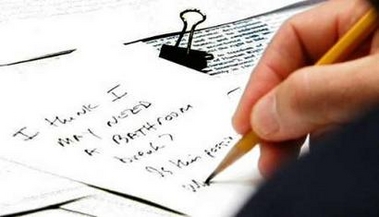
Break

U.S. President George W. Bush writes a note to Secretary of State Condoleezza Rice during a Security Council meeting at the 2005 World Summit and 60th General Assembly of the United Nations in New York September 14.

Reuters via Yahoo! News.

Hey, when you gotta go, you gotta go. And Bush really needs to go!

The Special Trustee responds

In a recent editorial in your newspaper, Cobell v. Norton litigation spokesman Bill McAllister says that reporters are not asking the Department of the Interior enough questions. I agree. There are many misconceptions about the litigation, the current state of the Indian Trust, our accounting activities, and our record keeping that need clarification, and I welcome questions.

Any good reporter will find that history has not been kind to the American Indian, and that there have been historical problems with the management of the Indian Trust. However, there is a widespread belief that the long running Cobell v. Norton litigation is about mismanagement and theft of Indian trust funds. This is not so. The case was filed to compel Interior to do an accounting of the funds that have been deposited to, and disbursed from, the trust, and to provide that accounting to each trust beneficiary.

We take the subject of trust management very seriously at Interior. In the past, department officials have stipulated to a number of trust management problems. For some years Interior officials and tribal leaders have been hard at work improving and modernizing the trust for the benefit of all trust account holders. Today business is different in Indian Country. It is detrimental to all Indian Trust account holders to propagate the notion, as plaintiffs and others do, that nothing has changed in ten years.

Newspapers have been printing emotional stories about people in Indian Country who, plaintiffs say, have been wronged by Interior. It is not difficult to find people to profile American Indians who are in need, and who deserve attention from the press. But it is manipulative to use these human interest stories to demonize Interior. Good reporters asking knowledgeable questions will find that those situations can have roots in other social, economic, or congressionally required management policies. Take, for example, the people who see oil pumps working on their land, but who receive checks for very small amounts. There are a number of questions that should be asked: Does the beneficiary own the subsurface mineral rights or did an heir sell them at some point? Is the ownership of the land highly divided among many beneficiaries? Because of early inheritance laws and probate codes passed by Congress, trust land is often divided among many heirs as it is passed down from generation to generation. It is common to have hundreds—even thousands—of Indian owners for one parcel of land. (If you divide a lease payment of $1,000 a month between 300 heirs, each beneficiary will receive a check for $3.33.) What’s more, many businesses are not interested in leasing Indian land simply because of the enormous amount of congressionally mandated regulations and red tape that lessees have to navigate. This, sadly, drives away competition, and results in the loss of higher market prices.

Many news articles include stories that are not factual but due to the Privacy Act we are unable to respond to these articles. …

— Ross Swimmer, Special Trustee for American Indians, letter to Native American Times

Ranking the Presidents

In February and March 2005, the Federalist Society and The Wall Street Journal asked an ideologically balanced group of 130 prominent professors of history, law, political science and economics to rate the presidents on a 5-point scale, with 5 meaning highly superior and 1 meaning well below average. Eighty-five scholars responded, and the presidents are ranked in order of mean score, adjusted to give equal weight to Democratic- and Republican-leaning respondents.

OpinionJournal – Extra, which has the chart.

“GOP-leaning scholars rated Mr. Bush the 6th-best president of all time, while Democratic ones rated him No. 35, or 6th-worst,” says James Taranto.

Caveat lector: The Federalist Society is a self-described “group of conservatives and libertarians.” The Wall Street Journal is editorially much the same. That may or may not have prejudiced this study. You decide.

Love, actually

In a review of a Bentley and a Jaguar, Dan Neil shows he understands the human heart (at least, when it comes to cars):

Comparing these cars reminds me of just how eccentric and personal, even irrational, tastes in cars can be. Whether you have $20,000 or $200,000 to spend, there are a set of imperatives that go beyond price and function — purely emotional, extra-textual concerns that make cars the expressive and interesting objects they are. After all, if car-buying were completely rational and deterministic — an X-and-Y plot of price and features — we’d all be driving Hyundai Sonatas. And do we really want that?

Sea Lions Sink Boat in Newport Harbor

Think of them as amphibious sumo wrestlers. A pack of rowdy sea lions has invaded Newport Harbor, sinking boats, thrashing docks and, with their nonstop barking, turning residents into sleepless zombies.

In a scene that has played out up and down the West Coast, the whiskered creatures are charming tourists but exasperating local officials, who are considering a bizarre array of methods to thwart the federally protected mammals.

Tonight, the Harbor Commission will discuss the situation, which took on added urgency after 18 sea lions piled onto a 37-foot sailboat this month and sank it.

Los Angeles Times

Nature is turning against us wherever we look.

Out in the Cold

It was on this day in 1812 that Napoleon’s army invaded the city of Moscow. He began the invasion of Russia in June of that year. The Russian forces kept retreating, burning the farmland as they went so the French wouldn’t be able to draw provisions from the land.

The troops were exhausted and hungry by the time they reached Moscow on this day, in 1812. The gates of the city were left wide open. And as the French came through, they noticed that all over the city small fires had begun. The Russians had set fire to their own city. By that night, the fires were out of control.

Napoleon watched the burning of the city from inside the Kremlin, and barely escaped the city alive. The retreat began across the snow-covered plains, one of the great disasters of military history. Thousands of troops died from starvation and hypothermia.

Of the nearly half million French soldiers who had set out in June on the invasion, fewer than 20,000 staggered back across the border in December.

The Writer’s Almanac

The confusion and horror of the French retreat through the Russian winter are well described. “The air itself,” wrote a French colonel, “was thick with tiny icicles which sparkled in the sun but cut one’s face drawing blood.” Another Frenchman recalled that “it frequently happened that the ice would seal my eyelids shut.” Prince Wilhelm of Baden, one of Napoleon’s commanders, gave the order to march on the morning of Dec. 7, only to discover that “the last drummer boy had frozen to death.” Soldiers had resorted to looting, stripping corpses and even to cannibalism by the time the march was over.

— From a Washington Post review of Moscow 1812: Napoleon’s Fatal March

F.A.A. Alerted on Qaeda in ’98

NewMexiKen wouldn’t want you to miss this news story:

American aviation officials were warned as early as 1998 that Al Qaeda could “seek to hijack a commercial jet and slam it into a U.S. landmark,” according to previously secret portions of a report prepared last year by the Sept. 11 commission. The officials also realized months before the Sept. 11 attacks that two of the three airports used in the hijackings had suffered repeated security lapses.

The New York Times

My question is this: Why was it seemingly so important to the White House to keep this part of the report secret? “Too sensitive for public release,” as the White House claimed? Or too sensitive for poltical purposes, as seems more likely?

Read the commission report here.

Take a Hint

Bill Maher:

And finally, New Rule: America must recall the president. That’s what this country needs. A good, old-fashioned, California-style recall election! Complete with Gary Coleman, porno actresses and action film stars. And just like Schwarzenegger’s predecessor here in California, George Bush is now so unpopular, he must defend his job against…Russell Crowe. Because at this point, I want a leader who will throw a phone at somebody. In fact, let’s have only phone throwers. Naomi Campbell can be the vice-president!

Now, I kid, but seriously, Mr. President, this job can’t be fun for you anymore. There’s no more money to spend. You used up all of that. You can’t start another war because you also used up the army. And now, darn the luck, the rest of your term has become the Bush family nightmare: helping poor people.

Yeah, listen to your mom. The cupboard’s bare, the credit card’s maxed out, and no one is speaking to you: mission accomplished! Now it’s time to do what you’ve always done best: lose interest and walk away. Like you did with your military service. And the oil company. And the baseball team. It’s time. Time to move on and try the next fantasy job. How about cowboy or spaceman?!

Now, I know what you’re saying. You’re saying that there’s so many other things that you, as president, could involve yourself in…Please don’t. I know, I know, there’s a lot left to do. There’s a war with Venezuela, and eliminating the sales tax on yachts. Turning the space program over to the church. And Social Security to Fannie Mae. Giving embryos the vote. But, sir, none of that is going to happen now. Why? Because you govern like Billy Joel drives. You’ve performed so poorly I’m surprised you haven’t given yourself a medal. You’re a catastrophe that walks like a man.

Herbert Hoover was a shitty president, but even he never conceded an entire metropolis to rising water and snakes.

On your watch, we’ve lost almost all of our allies, the surplus, four airliners, two Trade Centers, a piece of the Pentagon and the City of New Orleans…Maybe you’re just not lucky!

I’m not saying you don’t love this country. I’m just wondering how much worse it could be if you were on the other side. So, yes, God does speak to you, and what he’s saying is, “Take a hint.”

Cell phone music players — too soon to buy

After a week or so of testing the ROKR, along with a couple of competing music phones, my assistant Katie Boehret and I share Apple’s indifference. As a music player, the Motorola ROKR is OK, as are the two other music phones we tested. But none of them approaches either the style or the functionality of the iPod, and none lives up to the full potential of what a combined cellphone and music player could be.

The Mossberg Solution

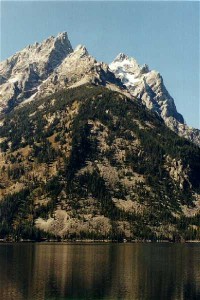
Grand Teton National Park

Jenny Lake… was formed on this date in 1950 by combining the much smaller National Park established in 1929 (which included just the Tetons and the lakes) and the Jackson Hole National Monument established in 1943. From the National Park Service:

Located in northwestern Wyoming, Grand Teton National Park protects stunning mountain scenery and a diverse array of wildlife. The central feature of the park is the Teton Range — an active, fault-block, 40-mile-long mountain front. The range includes eight peaks over 12,000 feet (3,658 m), including the Grand Teton at 13,770 feet (4,198 m). Seven morainal lakes run along the base of the range, and more than 100 alpine lakes can be found in the backcountry.

Elk, moose, pronghorn, mule deer, and bison are commonly seen in the park. Black bears are common in forested areas, while grizzlies are occasionally observed in the northern part of the park. More than 300 species of birds can be observed, including bald eagles and peregrine falcons.

NewMexiKen photo 1995