Tumacácori National Historical Park (Arizona)

… was proclaimed a national monument 100 years ago today. It was redisignated a national historical park in 1990.

Tumacácori National Historical Park

Tumacácori NHP protects three Spanish colonial mission ruins in southern Arizona: Tumacácori, Guevavi, and Calabazas. The adobe structures are on three sites, with a visitor center at Tumacácori. These missions are among more than twenty established in the Pimería Alta by Father Kino and other Jesuits, and later expanded upon by Franciscan missionaries.

Tumacácori National Historical Park

New Mexico State Fair

Life in the Land of Enchantment is … is … well enchanting. We’ve got the Zozobra, and UNM defeating Arizona in football, and the Balloon Fiesta coming up, and — of course, the New Mexico State Fair, the 70th edition of which began September 4th and runs through next Sunday.

NewMexiKen loves the fair and wrote about it here three years ago (with lots of photos). This year not so many photos, just three taken with my iPhone (click on each for a larger version).

This is Primo (I think). I thought the longhorn steer was posing, but I was a little slow and I see now that what I thought was a grin might have been more of a grimace. Later this week Primo and some of the other longhorn steers (which can weigh 2,500 pounds) will actually be ridden. Longhorn steer
Then I got to be a celebrity (I’ve already had more than my allotted 15 minutes, so I think this was extra celebrity time). At the Fair today they were constructing the world’s longest ristra. World's Longest Ristra Sign
Donna and I walked up just as they were finishing up and yours truly got to be the official very last person to add my three chiles (pictured here, only you can just see two) to the nearly 100 foot long ristra.

I was videotaped and interviewed by Channel 13 and everything — totally freezing and unable to say anything the least bit interesting or bright.

Chiles

Though, when asked my name, I was coherent enough to say Ken. And when asked for my whole name, I said, proudly, “NewMexiKen.”

And when asked if I was having a good time at the fair I said, “It’s always a great day at the Fair.”

And it is!

Call me irresponsible

Wreck

The college-age sister of a friend was T-boned this past week by a driver whose breathalyzer score was .19 (.08 is the legal limit).

The intoxicated driver was test driving a Ford 150 pickup from a local dealer. He ran a stop sign at 35 miles per hour.

Fortunately our friend’s sibling was not seriously injured.

But I’d own that car dealer before it was over if it was me.

Click image for larger version.

The election in 71 words

In order to disguise the fact that the core of his campaign is to continue the same Bush policies that have led 80 percent of the country to conclude we’re on the wrong track, McCain has decided to play the culture-war card. Obama may be a bit professorial, but at least he is trying to unite the country to face the real issues rather than divide us over cultural differences.

Tom Friedman

If you need a few more words:

McCain talks about how he would build dozens of nuclear power plants. Oh, really? They go for $10 billion a pop. Where is the money going to come from? From lowering taxes? From banning abortions? From borrowing more from China? From having Sarah Palin “reform” Washington — as if she has any more clue how to do that than the first 100 names in the D.C. phonebook?

Honor

Midshipmen are persons of integrity: They stand for that which is right.

They tell the truth and ensure that the full truth is known. They do not lie.

They embrace fairness in all actions. They ensure that work submitted as their own is their own, and that assistance received from any source is authorized and properly documented. They do not cheat.

They respect the property of others and ensure that others are able to benefit from the use of their own property. They do not steal.

United States Naval Academy Honor Code

Idea from Talking Points Memo.

Woof Woof

A friend sent NewMexiKen this amazing story:

I was in Wal-Mart buying a large bag of Purina for my Labrador Retriever and was in line to check out.

A woman behind me asked if I had a dog.

On impulse, I told her that no, I was starting The Purina Diet again, although I probably shouldn’t because I’d ended up in the hospital last time, but that I’d lost 50 pounds before I awakened in an intensive care ward with tubes coming out of most of my orifices and IVs in both arms. I told her that it was essentially a perfect diet and that the way that it works is to load your pants pockets with Purina nuggets and simply eat one or two every time you feel hungry & that the food is nutritionally complete so I was going to try it again.

I have to mention here that practically everyone in the line was by now enthralled with my story, particularly a tall guy behind her.

Horrified, she asked if I’d been poisoned and was that why I was in the hospital.

I said no … I’d been sitting in the street licking my balls and a car hit me.

It’s not funny

An Israeli doctor says…..”Medicine in my country is so advanced that we can take a kidney out of one man, put it in another, and have him looking for work in six weeks.”

A German doctor says……..”That is nothing, we can take a lung out of one person, put it in another, and have him looking for work in four weeks.”

A Russian doctor says…….”In my country, medicine is so advanced that we can take half a heart out of one person, put it in another, and have them both looking for work in two weeks.”

The Texas doctor, not to be outdone, says…”You guys are way behind. We took a man with no brain out of Texas, put him in the White House, and now half the country is looking for work.”

September 14th

Today is the birthday of Margaret Sanger, born on this date in 1879. From her obituary in The New York Times (1966):

As the originator of the phrase “birth control” and its best-known advocate, Margaret Sanger survived Federal indictments, a brief jail term, numerous lawsuits, hundreds of street-corner rallies and raids on her clinics to live to see much of the world accept her view that family planning is a basic human right.

The dynamic, titian-haired woman whose Irish ancestry also endowed her with unfailing charm and persuasive wit was first and foremost a feminist. She sought to create equality between the sexes by freeing women from what she saw as sexual servitude.

Hal Wallis was born on this date in 1899. A producer, Wallis was nominated for the Best Picture Oscar 15 times, winning for Casablanca in 1942. Wallis died in 1986.

The itinerant hall-of-fame basketball coach, Larry Brown, is 68 today.

Sam Neill was born in Northern Ireland 61 years ago today. Neill has appeared in numerous films, most famously The Hunt for Red October, Jurassic Park and as the ass-of-a-husband in The Piano.

Amy Winehouse is 25. With some rehab, next year on this date she might be 26.

William McKinley died on this date in 1901, seven days after being shot by Leon Czolgosz. Theodore Roosevelt became the 26th President of the United States, and the youngest ever. He was 42 years, 10-1/2 months old.

The Real Cold War

It was on this day in 1812 that Napoleon’s army invaded the city of Moscow. He began the invasion of Russia in June of that year. The Russian forces kept retreating, burning the farmland as they went so the French wouldn’t be able to draw provisions from the land.

The troops were exhausted and hungry by the time they reached Moscow on this day, in 1812. The gates of the city were left wide open. And as the French came through, they noticed that all over the city small fires had begun. The Russians had set fire to their own city. By that night, the fires were out of control.

Napoleon watched the burning of the city from inside the Kremlin, and barely escaped the city alive. The retreat began across the snow-covered plains, one of the great disasters of military history. Thousands of troops died from starvation and hypothermia.

Of the nearly half million French soldiers who had set out in June on the invasion, fewer than 20,000 staggered back across the border in December.

The Writer’s Almanac (2005)

The confusion and horror of the French retreat through the Russian winter are well described. “The air itself,” wrote a French colonel, “was thick with tiny icicles which sparkled in the sun but cut one’s face drawing blood.” Another Frenchman recalled that “it frequently happened that the ice would seal my eyelids shut.” Prince Wilhelm of Baden, one of Napoleon’s commanders, gave the order to march on the morning of Dec. 7, only to discover that “the last drummer boy had frozen to death.” Soldiers had resorted to looting, stripping corpses and even to cannibalism by the time the march was over.

— From a Washington Post review of Moscow 1812: Napoleon’s Fatal March

An important document for the Bush Library

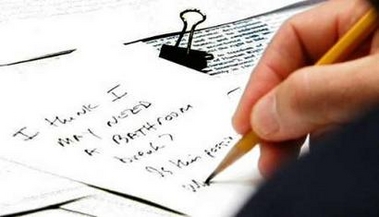
Break

U.S. President George W. Bush writes a note to Secretary of State Condoleezza Rice during a Security Council meeting at the 2005 World Summit and 60th General Assembly of the United Nations in New York September 14.

— Reuters via Yahoo! News.

Hey, when you gotta go, you gotta go. And Bush really needs to go!

[First posted here three years ago.]

Grand Teton National Park (Wyoming)

… was formed on this date in 1950 by combining the much smaller national park established in 1929 (which included just the Tetons and the lakes) and the Jackson Hole National Monument established in 1943. Today the park includes nearly 310,000 acres.

Teton.jpg

Located in northwestern Wyoming, Grand Teton National Park protects stunning mountain scenery and a diverse array of wildlife. The central feature of the park is the Teton Range — an active, fault-block, 40-mile-long mountain front. The range includes eight peaks over 12,000 feet (3,658 m), including the Grand Teton at 13,770 feet (4,198 m). Seven morainal lakes run along the base of the range, and more than 100 alpine lakes can be found in the backcountry.

Elk, moose, pronghorn, mule deer, and bison are commonly seen in the park. Black bears are common in forested areas, while grizzlies are occasionally observed in the northern part of the park. More than 300 species of birds can be observed, including bald eagles and peregrine falcons.

Grand Teton National Park

Black Jack

In all of American history, only two generals have held the rank General of the Armies, George Washington and John J. Pershing. 1

Pershing was born on this date in 1860. He graduated from West Point, 30th in a class of 77, and was stationed at Fort Bayard, New Mexico Territory (near Silver City), serving with General Miles in the last capture of Geronimo. Then he served in the Dakotas at the time of Wounded Knee. Pershing fought in Cuba during the Spanish-American War, and successfully (from the U.S. standpoint) controlled an insurrection while serving in the Philippines.

Still a captain, Pershing was promoted to Brigadier General by order of President Theodore Roosevelt in 1906. That is, he skipped major, lieutenant colonel and colonel. The fact that Pershing’s father-in-law was a U.S. senator and the president had attended the Pershings’ wedding had no bearing on this, of course.

Pershing’s wife and three daughters were killed in a fire in 1915 at their home at the Presidio in San Francisco while Pershing was commander of the Eighth Brigade there. A son survived.

In 1916-1917 Pershing led 12,000 American troops into Mexico in a failed attempt to capture Pancho Villa after his raid on Columbus, New Mexico.

In 1917, Pershing was named commander of the American Expeditionary Force — ultimately 2-1/2 million men. In his memoirs he wrote that his two biggest problems were keeping the British and French from incorporating the American army into theirs and getting the supplies he needed for such a large force.

Pershing was welcomed home a hero in 1919, became army chief of staff, and retired from active duty in 1924.

He died in 1948.

Pershing was nicknamed “Black Jack” as a result of his time as an officer in the 10th Cavalry, a unit of African-American or “Buffalo” soldiers.


1Pershing was awarded the rank in 1919 while still in the Army. Washington was promoted to the rank in 1976 as part of the Bicentennial. Grant, Sherman and Sheridan were four star generals of the army. Marshall, MacArthur, Eisenhower, Arnold and Bradley were five star generals of the army. Washington wore three stars, but by law is the highest ranking army officer. Pershing is second; he wore four gold stars.

September 13th

Today is the birthday

… of Milton S. Hershey, born on this date in 1857. Hershey, who only completed the fourth grade, developed a formula for milk chocolate that made what had been a luxury product into the first nationally marketed candy.

… of Sherwood Anderson, born on this date in 1876 in Camden, Ohio.

[Anderson] is best known for his short stories, “brooding Midwest tales” which reveal “their author’s sympathetic insight into the thwarted lives of ordinary people.” Between World War I and World War II, Anderson helped to break down formulaic approaches to writing, influencing a subsequent generation of writers, most notably Ernest Hemingway and William Faulkner. Anderson, who lived in New Orleans for a brief time, befriended Faulkner there in 1924 and encouraged him to write about his home county in Mississippi. (Library of Congress)

… of Bill Monroe, born on this date in 1911. The Father of Bluegrass Music was inducted into the Country Music Hall of Fame in 1970. In 1993, Monroe was a recipient of the Lifetime Achievement Award from the National Academy of Recording Arts and Sciences, an honor that placed him in the company of Louis Armstrong, Ray Charles and Paul McCartney. Monroe died in 1996.

Monroe is also an inductee of the Rock and Roll Hall of Fame:

Musical pioneer Bill Monroe is known as “the father of bluegrass music.” While Monroe would humbly say, “I’m a farmer with a mandolin and a high tenor voice,” he and His Blue Grass Boys essentially created a new musical genre out of the regional stirrings that also led to the birth of such related genres as Western Swing and honky-tonk. From his founding of the original bluegrass band in the Thirties, he refined his craft during six decades of performing. In so doing, he brought a new level of musical sophistication to what had previously been dismissed as “rural music.” Both as ensemble players and as soloists, Monroe and his Blue Grass Boys upped the ante in their chosen genre much the way Duke Ellington’s and Miles Davis’s bands did in jazz. Moreover, the tight, rhythmic drive of Monroe’s string bands helped clear a path for rock and roll in the Fifties. That connection became clear when a reworked song of Monroe’s, “Blue Moon of Kentucky,” became part of rock and roll history as the B side of Elvis Presley’s first single for Sun Records in 1954. Carl Perkins claimed that the first words Presley spoke to him were, “Do you like Bill Monroe?”

… of Mel Torme, born on this date in 1925. The “Velvet Fog” was a wonderful jazz singer, but his greatest legacy is writing “The Christmas Song” — “Chestnuts roasting on an open fire…”. Torme died in 1999.

And it’s the anniversary of the inspiration for our most famous song:

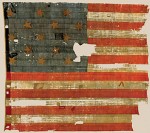
As the evening of September 13, 1814, approached, Francis Scott Key, a young lawyer who had come to negotiate the release of an American friend, was detained in Baltimore harbor on board a British vessel. Throughout the night and into the early hours of the next morning, Key watched as the British bombed nearby Fort McHenry with military rockets. As dawn broke, he was amazed to find the Stars and Stripes, tattered but intact, still flying above Fort McHenry.

Key’s experience during the bombardment of Fort McHenry inspired him to pen the words to “The Star-Spangled Banner.” He adapted his lyrics to the tune of a popular drinking song, “To Anacreon in Heaven,” and the song soon became the de facto national anthem of the United States of America, though Congress did not officially recognize it as such until 1931.

Library of Congress

Star-spangled Banner
 
 
The Smithsonian Institution, which has the original “star-spangled banner,” has details about the flag.


On the road again

Debby, official younger sister of NewMexiKen, has graced these pages from the earliest days with her comments and from time-to-time her stories. You may remember not long ago reading about her day on horseback rounding up cattle.

Anyway for family reasons — among others, she just became a grandma — Debby has moved back to Arizona. And she loves being out in the country. How far out in the country you ask. Would you believe she just moved into a town and got P.O. Box 5?

Blame Ike

Wholesale — that’s wholesale — gasoline hit $4.85 today, up from $3 Tuesday because the refineries in southeast Texas are closed and aren’t making any gasoline for now.

That’s wholesale — four-eighty-five a gallon.

But the price of crude oil is down to near $100 you say. How can that be?

Because the southeast Texas refineries are closed. They aren’t buying any crude oil because they aren’t using what they have because they aren’t making any gasoline.

Best line of the day, so far

I have had a strong and a long relationship on national security, I’ve been involved in every national crisis that this nation has faced since Beirut, I understand the issues, I understand and appreciate the enormity of the challenge we face from radical Islamic extremism.

I am prepared. I am prepared. I need no on-the-job training.

I wasn’t a mayor for a short period of time. I wasn’t a governor for a short period of time.

John McCain, Republican debate, October 21, 2007

Canyonlands National Park (Utah)

… was authorized on this date 44 years ago. From the National Park Service:

Canyonlands.jpg

Canyonlands National Park preserves a colorful landscape of sedimentary sandstones eroded into countless canyons, mesas and buttes by the Colorado River and its tributaries. The Colorado and Green rivers divide the park into four districts: the Island in the Sky, the Needles, the Maze and the rivers themselves. While the districts share a primitive desert atmosphere, each retains its own character and offers different opportunities for exploration and learning.

Nine Twelve

George Jones is 77.

In many ways Jones is one of country music’s last vital links to its own rural past—a relic from a long-gone time and place before cable TV and FM rock radio and shopping malls, an era when life still revolved around the Primitive Baptist Church, the honky-tonk down the road, and Saturday nights listening to the Grand Ole Opry on the radio. The fact that Jones himself has changed little over the years, and at times seems to be genuinely bewildered by the immensity of his own talent and the acclaim it has brought him, have merely enhanced his credibility.

Like Hank Williams before him, Jones has emerged—quite unintentionally—as an archetype of an era that most likely will never come around again. He is a singer who has earned his stature the hard way: by living his songs. His humble origins, his painful divorces, his legendary drinking and drugging, and his myriad financial, legal, and emotional problems have, over the years, merely confirmed his sincerity and enhanced his mystique, earning him a cachet that, in country music circles, approaches canonization.

Country Music Hall of Fame

Maria Muldaur is 65. Muldaur, famous for “Midnight at the Oasis,” has an album of Shirley Temple songs (2004).

Joe Pantoliano is 57.

Ruben Studdard is 30.

Yao Ming is 28.

Oscar-winner Jennifer Hudson is 27 today.

Jesse Owens was born on September 12th in 1913. ESPN.com ranked Owens the sixth best athlete of the 20th century:

On May 25 [1935] in Ann Arbor, Mich., Owens couldn’t even bend over to touch his knees. But as the sophomore settled in for his first race, he said the pain “miraculously disappeared.”

3:15 — The “Buckeye Bullet” ran the 100-yard dash in 9.4 seconds to tie the world record.

3:25 — In his only long jump, he leaped 26-8 1/4, a world record that would last 25 years.

3:34 — His 20.3 seconds bettered the world record in the 220-yard dash.

4:00 — With his 22.6 seconds in the 220-yard low hurdles, he became the first person to break 23 seconds in the event.

For most athletes, Jesse Owens’ performance one spring afternoon in 1935 would be the accomplishment of a lifetime. In 45 minutes, he established three world records and tied another.

But that was merely an appetizer for Owens. In one week in the summer of 1936, on the sacred soil of the Fatherland, the master athlete humiliated the master race.

100 Photographs That Changed the World

NewMexiKen posts this every September 12, so no need to be different this — the sixth — year. Here’s what I wrote two years ago:

View 28 of the 100 Photographs that Changed the World, originally from Life magazine. NewMexiKen has posted this link each year on this date and I hesitated this morning. I mean, why repeat it for the fourth time?

I then went and looked at the 28 photos and said to myself, “Oh, that’s why.”