This article about a woman journalist sent to cover the Cleveland Indians on a road trip in 1957 is interesting. She’s 89 now.
The Tax-Cut Con
This short excerpt is from an article by Paul Krugman published in The New York Times Magazine seven years ago today. Krugman argued we are not over-taxed as a nation, the wealthy received the preponderance of the Bush tax-cuts, and a huge fiscal crisis is looming.
[T]he coming crisis will allow conservatives to move the nation a long way back toward the kind of limited government we had before Franklin Roosevelt. Lack of revenue, [Grover Norquist] says, will make it possible for conservative politicians — in the name of fiscal necessity — to dismantle immensely popular government programs that would otherwise have been untouchable.
In [tax critic Grover] Norquist’s vision, America a couple of decades from now will be a place in which elderly people make up a disproportionate share of the poor, as they did before Social Security. It will also be a country in which even middle-class elderly Americans are, in many cases, unable to afford expensive medical procedures or prescription drugs and in which poor Americans generally go without even basic health care. And it may well be a place in which only those who can afford expensive private schools can give their children a decent education.
Seven. Years. Ago. Think he was wrong?
Redux post of the day
I thought this was interesting enough to bring back. It was posted in 2006.
Sounding Off
NewMexiKen is reading Mark Katz’s Capturing Sound: How Technology Has Changed Music. It’s a well-regarded book that I am finding interesting, though actually I was looking more for a history of the early recorded music business. Katz’s interest is mostly from the musicologist point of view.
Still, some interesting stuff.
One of the most basic manipulations is splicing, in which passages recorded at different times are joined together. The Beatles’ “Strawberry Fields Forever” (1967) provides a famous example. The Beatles did over two dozen takes of the song, none of which completely satisfied John Lennon. But he did like the first half of Take 7 and the second half of Take 26. So he asked George Martin, their producer, to put the two together. Unfortunately, they were in different keys and tempos. The two takes, however, were related in such a way that when one was sped up and the other slowed down so that the tempos matched, the pitches also matched. Thus the two takes could be joined, the splice occurring at about 0:59 on the word going in “Let me take you down ’cause I’m going to Strawberry Fields.” Although the splice is nearly undetectable, the slightly altered speed of Lennon’s voice helps give the song its distinctively dreamlike quality.
Another passage notes the impact of the Depression and free radio on the phonograph business:
“In 1927, 104 million discs and 987,000 machines were sold; by 1932, the numbers had plummeted to 6 million and 40,000.”
Maybe our present day music industry should quit its whining.
The Real Cold War
It was on this day in 1812 that Napoleon’s army invaded the city of Moscow. He began the invasion of Russia in June of that year. The Russian forces kept retreating, burning the farmland as they went so the French wouldn’t be able to draw provisions from the land.
The troops were exhausted and hungry by the time they reached Moscow on this day, in 1812. The gates of the city were left wide open. And as the French came through, they noticed that all over the city small fires had begun. The Russians had set fire to their own city. By that night, the fires were out of control.
Napoleon watched the burning of the city from inside the Kremlin, and barely escaped the city alive. The retreat began across the snow-covered plains, one of the great disasters of military history. Thousands of troops died from starvation and hypothermia.
Of the nearly half million French soldiers who had set out in June on the invasion, fewer than 20,000 staggered back across the border in December.
— The Writer’s Almanac (2005)
The confusion and horror of the French retreat through the Russian winter are well described. “The air itself,” wrote a French colonel, “was thick with tiny icicles which sparkled in the sun but cut one’s face drawing blood.” Another Frenchman recalled that “it frequently happened that the ice would seal my eyelids shut.” Prince Wilhelm of Baden, one of Napoleon’s commanders, gave the order to march on the morning of Dec. 7, only to discover that “the last drummer boy had frozen to death.” Soldiers had resorted to looting, stripping corpses and even to cannibalism by the time the march was over.
— From a Washington Post review of Moscow 1812: Napoleon’s Fatal March
September 14th
Today is the birthday of Margaret Sanger, born on this date in 1879. From her obituary in The New York Times (1966):
As the originator of the phrase “birth control” and its best-known advocate, Margaret Sanger survived Federal indictments, a brief jail term, numerous lawsuits, hundreds of street-corner rallies and raids on her clinics to live to see much of the world accept her view that family planning is a basic human right.
The dynamic, titian-haired woman whose Irish ancestry also endowed her with unfailing charm and persuasive wit was first and foremost a feminist. She sought to create equality between the sexes by freeing women from what she saw as sexual servitude.
Hal Wallis was born on this date in 1899. A producer, Wallis was nominated for the Best Picture Oscar 15 times, winning for Casablanca in 1942. Wallis died in 1986.
The itinerant hall-of-fame basketball coach, Larry Brown, is 70 today.
Davenie Johanna Heatherton was born 66 years ago today. She was called Joey and had a lot of appearances when she was 16-25 on various TV shoes with older male singers — Perry Como, Dean Martin, Andy Williams — Bob Hope’s Christmas shows for the troops. It was mostly about her looks.
Sam Neill was born in Northern Ireland 63 years ago today. Neill has appeared in numerous films, most famously The Hunt for Red October, Jurassic Park and as the ass-of-a-husband in The Piano.
Amy Winehouse has made it to 27.
William McKinley died on this date in 1901, seven days after being shot by Leon Czolgosz. Theodore Roosevelt became the 26th President of the United States, and the youngest ever. He was 42 years, 10-1/2 months old.
And it was on September 14th in 1814 that Francis Scott Key wrote the poem that became “The Star-Spangled Banner.” The Writer’s Almanac has a good telling of the tale.
Grand Teton National Park (Wyoming)
… was formed 60 years ago today by combining the much smaller national park established in 1929 (which included just the Tetons and the lakes) and the Jackson Hole National Monument established in 1943. Today the park includes nearly 310,000 acres.
Located in northwestern Wyoming, Grand Teton National Park protects stunning mountain scenery and a diverse array of wildlife. The central feature of the park is the Teton Range — an active, fault-block, 40-mile-long mountain front. The range includes eight peaks over 12,000 feet (3,658 m), including the Grand Teton at 13,770 feet (4,198 m). Seven morainal lakes run along the base of the range, and more than 100 alpine lakes can be found in the backcountry.
Elk, moose, pronghorn, mule deer, and bison are commonly seen in the park. Black bears are common in forested areas, while grizzlies are occasionally observed in the northern part of the park. More than 300 species of birds can be observed, including bald eagles and peregrine falcons.

Too close for comfort
As Garret at dangerousmeta! put it, “Some of these are legit, others are natural selection in action.”
Idle but frustrated thought
Anyone know the secret to Angry Birds? It can’t be this hard!
The Plains of Abraham

It was on September 13, 1759, that British military and naval forces under General James Wolfe defeated the French under Marquis Louis-Joseph de Montcalm on the fields once belonging to Abraham Martin outside Québec. Both commanders were killed. That’s Wolfe’s death on the field above as depicted by Benjamin West. Montcalm died the next morning.
Fewer than 10,000 combatants were on the Plains of Abraham that day for a battle lasting just about an hour. Yet, and even though the war continued for four more years, it was the pivotal battle for North America. Controlling Québec meant controlling the St. Lawrence River. In the Treaty of Paris that ended the Seven Years War in 1763 — it is known as the French and Indian War in America, as the War of the Conquest in Québec — France ceded to Britain its claim to Canada, the Great Lakes and the Mississippi Valley.
The British, unable to pierce Québec’s defenses throughout July, had launched a war of terror. An estimated 1,400 farms had been destroyed — no one knows the number of murders, rapes, thefts and scalpings. Even so, the French held, well arrayed against an assault on the cliffs and shore below the city, and supplied from up river against a siege.
Finally, perhaps in desperation, Wolfe moved his army up river past Québec. On the night of September 12th, he let the ebbing river bring them back down to an obscure pathway up the cliff to the Plains of Abraham. By daylight, seven British battalions were on the field; five more were still coming up the path and artillery was being manhandled up the cliff as well (4,500 men in all). Montcalm, reportedly rattled by Wolfe’s surprise move, decided to assault the probably superior British force in a frontal assault.
The French marched on the seven forward British battalions; the Redcoats were formed two deep, a half-mile wide. The British were ordered not to fire until the enemy was at 40 yards. The French fired at 125-150 yards, to little effect — though they did mortally wound Wolfe. The British held fire. The French attacked without cohesion. The British stood still holding fire.
When the French advance reached 40 yards the British fired. From then it was a rout. In fact the British command needed to order its pursuing troops back. British discipline reformed before French reserves arrived from behind; the arriving French did not engage. (The outcome might have been different if Montcalm had kept his cool and waited to trap the British before attacking.) Each side had about 650 casualties.
The British dug in for a siege. The town, its supplies now cut off, capitulated on the 18th.
And the British spent a miserable Québec winter with nothing to eat — they had destroyed all the farms before harvest.
The British captured Montréal the following September. Canada was British.
September 13th
Today is the birthday
… of Milton S. Hershey, born on this date in 1857. Hershey, who only completed the fourth grade, developed a formula for milk chocolate that made what had been a luxury product into the first nationally marketed candy.
… of Sherwood Anderson, born on this date in 1876 in Camden, Ohio.
[Anderson] is best known for his short stories, “brooding Midwest tales” which reveal “their author’s sympathetic insight into the thwarted lives of ordinary people.” Between World War I and World War II, Anderson helped to break down formulaic approaches to writing, influencing a subsequent generation of writers, most notably Ernest Hemingway and William Faulkner. Anderson, who lived in New Orleans for a brief time, befriended Faulkner there in 1924 and encouraged him to write about his home county in Mississippi.
 … of Bill Monroe, born on this date in 1911. The Father of Bluegrass Music was inducted into the Country Music Hall of Fame in 1970. In 1993, Monroe was a recipient of the Lifetime Achievement Award from the National Academy of Recording Arts and Sciences, an honor that placed him in the company of Louis Armstrong, Ray Charles and Paul McCartney. Monroe died in 1996.
That’s a photo of Monroe’s Gibson Lloyd Loar F5 1923 Mandolin, bought used from a barbershop in the early 1940s for $150. Most of Monroe’s work thereafter, including his composing, was performed on the instrument — until it was smashed with a fireplace poker by a jilted lover in 1985. Gibson repaired the mandolin, gluing together some 500 pieces. Remarkably, its sound was not diminished and Monroe used it until the end of his career — with a rattlesnake tail inside to absorb moisture and discourage mice.
Monroe is also an inductee of the Rock and Roll Hall of Fame:
Musical pioneer Bill Monroe is known as “the father of bluegrass music.” While Monroe would humbly say, “I’m a farmer with a mandolin and a high tenor voice,” he and His Blue Grass Boys essentially created a new musical genre out of the regional stirrings that also led to the birth of such related genres as Western Swing and honky-tonk. From his founding of the original bluegrass band in the Thirties, he refined his craft during six decades of performing. In so doing, he brought a new level of musical sophistication to what had previously been dismissed as “rural music.” Both as ensemble players and as soloists, Monroe and his Blue Grass Boys upped the ante in their chosen genre much the way Duke Ellington’s and Miles Davis’s bands did in jazz. Moreover, the tight, rhythmic drive of Monroe’s string bands helped clear a path for rock and roll in the Fifties. That connection became clear when a reworked song of Monroe’s, “Blue Moon of Kentucky,” became part of rock and roll history as the B side of Elvis Presley’s first single for Sun Records in 1954. Carl Perkins claimed that the first words Presley spoke to him were, “Do you like Bill Monroe?”
… of Mel Tormé, born on this date in 1925. The “Velvet Fog” was a wonderful jazz singer, but his greatest legacy is writing “The Christmas Song” — “Chestnuts roasting on an open fire…”. Tormé died in 1999.
And it’s the anniversary of the inspiration for our most famous song:
As the evening of September 13, 1814, approached, Francis Scott Key, a young lawyer who had come to negotiate the release of an American friend, was detained in Baltimore harbor on board a British vessel. Throughout the night and into the early hours of the next morning, Key watched as the British bombed nearby Fort McHenry with military rockets. As dawn broke, he was amazed to find the Stars and Stripes, tattered but intact, still flying above Fort McHenry.
…Key’s experience during the bombardment of Fort McHenry inspired him to pen the words to “The Star-Spangled Banner.” He adapted his lyrics to the tune of a popular drinking song, “To Anacreon in Heaven,” and the song soon became the de facto national anthem of the United States of America, though Congress did not officially recognize it as such until 1931.
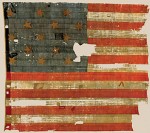
The Smithsonian Institution, which has the original “star-spangled banner,” has details about the flag.
Black Jack
 In all of American history, only two generals have held the rank General of the Armies, George Washington and John J. Pershing.*
Pershing was born on September 13 in 1860. He graduated from West Point, 30th in a class of 77, and was stationed at Fort Bayard, New Mexico Territory (near Silver City), serving with General Miles in the last capture of Geronimo. Then he served in the Dakotas at the time of Wounded Knee. Pershing fought in Cuba during the Spanish-American War, and successfully (from the U.S. standpoint) controlled an insurrection while serving in the Philippines.
Still a captain, Pershing was promoted to Brigadier General by order of President Theodore Roosevelt in 1906. That is, he skipped major, lieutenant colonel and colonel. The fact that Pershing’s father-in-law was a U.S. senator and the president had attended the Pershings’ wedding had no bearing on this, of course.
Pershing’s wife and three daughters were killed in a fire in 1915 at their home at the Presidio in San Francisco while Pershing was commander of the Eighth Brigade there. A son survived.
In 1916-1917 Pershing led 12,000 American troops into Mexico in a failed attempt to capture Pancho Villa after his raid on Columbus, New Mexico.
In 1917, Pershing was named commander of the American Expeditionary Force — ultimately 2-1/2 million men. In his memoirs he wrote that his two biggest problems were keeping the British and French from incorporating the American army into theirs and getting the supplies he needed for such a large force.
Pershing was welcomed home a hero in 1919, became army chief of staff, and retired from active duty in 1924.
He died in 1948.
Pershing was nicknamed “Black Jack” as a result of his time as an officer in the 10th Cavalry, a unit of African-American or “Buffalo” soldiers.
* Pershing was awarded the rank General of the Armies in 1919 while still in the Army. Washington was promoted to the rank in 1976 as part of the Bicentennial. Grant, Sherman and Sheridan were four star generals of the army. Marshall, MacArthur, Eisenhower, Arnold and Bradley were five star generals of the army. Washington wore three stars, but by law is the highest ranking army officer. Pershing is second; he wore four gold stars.
Why I Like WAR (with Poker talk)
Great baseball stat stuff from Joe Posnanski.
Gotta love the national pastime. Baseball is so great that we (me at least) can enjoy reading not only about baseball, and not only about baseball stats, but analysis of the nature of the stats.
As Posnanski says, “This is all just a goofy Batman could beat Superman talk.”
Precisely!
Look: One of the great things about watching and enjoying sports is that there are no rules. You can believe what you want to believe. It’s supposed to be fun. Dan Quisenberry said the best thing about baseball is that there’s no homework … I would add there are no pop quizzes. If you want to believe that baseball is won entirely by heart, that RBIs and wins are the two most important numbers, that defense can be measured best and entirely by what you see, that Jack Morris and not Bert Blyleven belongs in the Hall of Fame, that numbers deaden the sport, you are absolutely entitled — more than entitled, you are empowered to see the game as you want to see it, enjoy it as you want to enjoy it. I’m not sure what you’re doing here, 2,000 or so words into this essay about WAR, but you absolutely should watch all sports for the joy of it. I just hope you’re not running a team I like.
In defense of Babe Ruth, Barry Bonds, jaywalkers, and all the other scofflaws that make America great
Bill James begins:
First of all, I have absolutely no doubt that, had steroids and other performance-enhancing drugs existed during Babe Ruth’s career, Babe Ruth would not only have used them, he would have used more of them than Barry Bonds. I don’t understand how anyone can be confused about this. The central theme of Babe Ruth’s life, which is the fulcrum of virtually every anecdote and every event of his career, is that Babe Ruth firmly believed that the rules did not apply to Babe Ruth.
It’s a provocative essay really more about crime and America than it is about baseball.
Highly recommended.
Brave new world
Once you are in the app, you tap on “deposits,” which activates your iPhone’s camera and brings up a viewscreen with some guides and commands. Line up the check with the guidelines on your screen, hold the iPhone steady and push an onscreen button. You then do the same for the back of the check. (The endearing Chase TV ads with newlyweds in bed also show how.)
. . .So that’s pretty amazing. I came home last night, opened some mail and found a reimbursement check from my dental insurer. About two minutes later, I had deposited the check. From my dining room.
Chase and USAA are the leaders with this. C’mon the rest of you.
Not that I get any checks.
Rox
The Rockies are 17-4 over the past three weeks.
Walk-off pinch-hit HR by Giambi today.
Silly trivia
Quick, without thinking, can you name the six Major League Baseball teams (out of 30) that do not have a city in their name?
War and Footnotes
Well, about 1/10th of the way in I decided that if I was going to invest the time to read War and Peace I really ought to do it with the richest translation available. I did some reading on Russian translations and decided the free electronic version I had wasn’t it.
So I downloaded the free sample of the preferred translation — Pevear and Volokhonsky (2007).
Pevear and Volokhonsky have, rightly I think, left the French in Tolstoy’s Russian novel intact. I can read some French, but very little, so thankfully they have translated the French and provided those translations in footnotes. Alas, the electronic version has the French translation footnotes as links. The dead-tree version has those translation footnotes a glance away at the bottom of the page. Much, much better. Chalk one up for paper and ink.
[Tolstoy himself translated the French to Russian as notes. I believe Pevear and Volokhonsky have relied on his translations.]
 .
.And a handcart to carry it around on.
I’ve enjoyed what I’ve read so far.
9-12
 Dickie Moore of the “Our Gang” films is 85 today. That’s him with the watermelon and knife in the poster from a re-release of a 1932 film.
George Jones is 79 today.
In many ways Jones is one of country music’s last vital links to its own rural past—a relic from a long-gone time and place before cable TV and FM rock radio and shopping malls, an era when life still revolved around the Primitive Baptist Church, the honky-tonk down the road, and Saturday nights listening to the Grand Ole Opry on the radio. The fact that Jones himself has changed little over the years, and at times seems to be genuinely bewildered by the immensity of his own talent and the acclaim it has brought him, have merely enhanced his credibility.
Like Hank Williams before him, Jones has emerged—quite unintentionally—as an archetype of an era that most likely will never come around again. He is a singer who has earned his stature the hard way: by living his songs. His humble origins, his painful divorces, his legendary drinking and drugging, and his myriad financial, legal, and emotional problems have, over the years, merely confirmed his sincerity and enhanced his mystique, earning him a cachet that, in country music circles, approaches canonization.
Anniversary: Ten Years of Hits
Maria Muldaur, famous for “Midnight at the Oasis,” is 67.
Joe Pantoliano is 59.
Ruben Studdard is 32.
Yao Ming is 30.
Oscar-winner Jennifer Hudson is 29 today.
Henry Louis Mencken was born in Baltimore on September 12th in 1880.
At the height of his career, he edited and wrote for The American Mercury magazine and the Baltimore Sun newspaper, wrote a nationally syndicated newspaper column for the Chicago Tribune, and published two or three books every year. His masterpiece was one of the few books he wrote about something he loved, a book called The American Language (1919), a history and collection of American vernacular speech. It included a translation of the Declaration of Independence into American English that began, “When things get so balled up that the people of a country got to cut loose from some other country, and go it on their own hook, without asking no permission from nobody, excepting maybe God Almighty, then they ought to let everybody know why they done it, so that everybody can see they are not trying to put nothing over on nobody.”
Jesse Owens was born on September 12th in 1913. ESPN.com ranked Owens the sixth best athlete of the 20th century:
On May 25 [1935] in Ann Arbor, Mich., Owens couldn’t even bend over to touch his knees. But as the sophomore settled in for his first race, he said the pain “miraculously disappeared.”
3:15 — The “Buckeye Bullet” ran the 100-yard dash in 9.4 seconds to tie the world record.
3:25 — In his only long jump, he leaped 26-8 1/4, a world record that would last 25 years.
3:34 — His 20.3 seconds bettered the world record in the 220-yard dash.
4:00 — With his 22.6 seconds in the 220-yard low hurdles, he became the first person to break 23 seconds in the event.
For most athletes, Jesse Owens’ performance one spring afternoon in 1935 would be the accomplishment of a lifetime. In 45 minutes, he established three world records and tied another.
But that was merely an appetizer for Owens. In one week in the summer of 1936, on the sacred soil of the Fatherland, the master athlete humiliated the master race.
This from Owens’ New York Times obituary in 1980:
The United States Olympic track team, of 66 athletes, included 10 blacks. The Nazis derided the Americans for relying on what the Nazis called an inferior race, but of the 11 individual gold medals in track won by the American men, six were won by blacks.
The hero was Mr. Owens. He won the 100-meter dash in 10.3 seconds, the 200-meter dash in 20.7 seconds and the broad jump at 26 feet 5 1/2 inches, and he led off for the United States team that won the 400-meter relay in 39.8 seconds.
His individual performances broke two Olympic records and, except for an excessive following wind, would have broken the third. The relay team broke the world record. His 100-meter and 200-meter times would have won Olympic medals through 1964, his broad- jump performance through 1968.
Actually, Mr. Owens had not been scheduled to run in the relay. Marty Glickman and Sam Stoller were, but American Olympic officials, led by Avery Brundage, wanted to avoid offending the Nazis. They replaced Mr. Glickman and Mr. Stoller, both Jews, with Mr. Owens and Ralph Metcalfe, both blacks.
Line of the day
“According to New Hampshire’s WMUR Channel 9 News, three local men, Mario Rojas, Leonardo Barroso and Victor Rodriguez, have burglarized more than 18 homes in the Nashua area of New Hampshire simply by checking status updates on Facebook and then pillaging houses of victims who announced on the social network that they were not home.”
Zelary
Tonight I watched Zelary, a 2003 film from the Czech Republic. This beautifully filmed drama tells the story of a nurse during World War II who must leave her surgeon lover and the city when they are discovered by the Gestapo as part of the resistance. She is taken to a remote mountain community to save her life, putting all who help her there in jeopardy, including the man she marries to make her arrival appear convincing. It’s more romance than war film, finely-paced, with a number of interesting characters and subplots.
As with many European films, I found I had to slow down and savor the film. It was rewarding when I did.
Zelary is in Czech with English subtitles. My copy was a DVD from Netflix.
What he said
An excerpt:
Forget about people actually supporting unions in a labor disagreement: they apparently don’t even want to see them, not if it’s going to delay a football game by three whole seconds. There were actually arguments across the media landscape to the effect that NFL players were out of line bringing their labor disagreement into our living rooms, the implication being that any display of union activity is somehow unseemly or ( I love this) selfish. We have a whole reality-show culture celebrating the cause of people eating centipedes and stabbing each other in the back for cash prizes and fame, but football players quietly showing union solidarity is tasteless. If you can explain that one to me, please don’t hesitate to write in.
Best line of the day
“In contrast, we have the absurd, exasperating furor over an obscure Florida pastor, the Rev. Yosemite Sam, who threatens to gather his literally dozens of parishioners around a cheery bonfire of Korans.”
Best line of the day
“Nine years later, the main fact of our lives is the overwhelming force of unreason. Evidence, knowledge, argument, proportionality, nuance, complexity, and the other indispensable tools of the liberal mind don’t stand a chance these days against the actual image of a mob burning an effigy, or the imagined image of a man burning a mound of books.”
Best line of the day then
“This tragedy will only be magnified if it is exploited for political gain. Politicians who wrap themselves in the flag while relentlessly pursuing their usual partisan agenda are not true patriots, and history will not forgive them.”
Paul Krugman September 14, 2001
September 11th
Two immortal football coaches share this birthday. Paul “Bear” Bryant was born on this date in 1913. Tom Landry was born on this date in 1924.
U.S. Senator Daniel Akaka of Hawaii is 86. Akaka is the third oldest U.S. senator, but the second oldest from Hawaii (Senator Daniel Inouye is four days older.) Akaka is the only senator with Hawaiian and Chinese ancestry.
Actor Earl Holliman is 82. Holliman is perhaps best know as Lt. Bill Crowley on Police Woman with Angie Dickinson.
David Broder is 81.
Mickey Hart of the Grateful Dead is 67.
Musician Leo Kottke is 65.
One-time Oscar nominee Amy Madigan is 60. She was nominated for Twice in a Lifetime in 1985. She was the wife who owned the farm in Field of Dreams. Ms. Madigan has been married to Ed Harris 27 years.
Sportscaster Lesley Visser is 57. Visser was the first woman to receive the Pro Football Hall of Fame’s Pete Rozelle Radio-Television Award.
Oscar nominee for best supporting actress for her performance in Sideways, Virginia Madsen is 49.
Kristy McNichol is 48.
Harry Connick Jr. is 43. He grew up in New Orleans where his father was D.A.
Ludacris is 33.
William Sydney Porter was born on this date in 1852. We know him as O. Henry.
The feds did an audit of the bank he’d been working at, and when they found a bunch of discrepancies, they decided to indict him on federal embezzlement charges. His wife’s dad posted bail for him, but instead of sticking around for trial, O. Henry fled to New Orleans and then to Honduras, where he stayed for months. But when he found out that his beloved wife was on the verge of dying from her tuberculosis, he came back to Texas and turned himself in. Soon after, his wife died. He stood trial, was convicted of embezzlement, and was sent away to a federal penitentiary in Ohio.
He wrote short stories there, and he came up with the pseudonym O. Henry. Magazine editors were clueless that the stories they published were written by an inmate locked up in a federal penitentiary.
He got out of jail and wrote fast and furiously, about 400 short stories in those years following his release. He became famous, and an alcoholic, and he died less than a decade after getting out of jail, at the age of 47, from liver disease.
A particular favorite is The Ransom of Red Chief.
D. H. Lawrence was born on this date in 1885.
He had an incredibly difficult life. He was a teacher, but he caught tuberculosis as a young man and eventually became too sick to teach. During World War I, the British government suspected he was a German spy, because his wife was German and he opposed the war. Most of all, he struggled against censorship. More than almost any other writer at the time, he believed that in order to write about human experience, novelists had to write explicitly about sex. When he published his first important novel, Sons and Lovers (1913), he found that his editor had deleted numerous erotic passages without his permission. When he published his novel The Rainbow in 1915, Scotland Yard seized most of the printed copies under charges of obscenity. He was blacklisted as an obscene writer and none of the magazines in England would publish anything he wrote. He finished Women in Love in 1916, but couldn’t get it published until 1920, and even then he could only publish it privately.
Lawrence was finally allowed to leave England when World War I was over, and he was so happy that he traveled everywhere, to Ceylon [now Sri Lanka], Australia, Tahiti, Mexico, and New Mexico.
He eventually moved back to Europe and worked on his last big novel, Lady Chatterley’s Lover (1928). It was banned in England and America. One British critic called it “the most evil outpouring that has ever besmirched the literature of our country.” It was not widely available until 1960, when Penguin published an unexpurgated edition.