The greatest conservation president since T.R.

Twenty-nine years ago today President Jimmy Carter took abrupt and sweeping action to preserve 17 endangered areas in Alaska. Carter used the 1906 Antiquities Act to prevent exploitation while the Congress deliberated. Carter’s proclamation established:

Admiralty Island National Monument
Aniakchak National Monument
Becharof National Monument
Bering Land Bridge National Monument
Cape Krusenstern National Monument
Denali National Monument
Gates of the Arctic National Monument
Enlarging the Glacier Bay National Monument
Enlarging the Katmai National Monument
Kenai Fjords National Monument
Kobuk Valley National Monument
Lake Clark National Monument
Misty Fiords National Monument
Noatak National Monument
Wrangell-St. Elias National Monument
Yukon-Charley National Monument
Yukon Flats National Monument

Two years and a day later the Congress passed the Alaska National Interest Lands Conservation Act.

The Wave

Now, I’d seen these photos. But you certainly couldn’t call me a Wave fanatic. I was drawn here by my cynicism. I expected an up-close tour of the Wave to fall way short of the hype. Call me a hater, but how many times have you read over-hyped stories about places that just don’t live up to the billing? It’s like when you meet your favorite celebrity, and he turns out to be a short, balding jerk. Still, I was curious.

Perhaps the title of the article from which the above paragraph was taken will give you an idea of the outcome — Arizona’s Wave rock formation a stone-cold stunner.

Road tripping

NewMexiKen has taken road trips of 400 miles or more scores of times in my life. I have no idea how many miles I might have driven (or been the passenger), but 200,000 does not seem far-fetched.

Driving from Denver to Albuquerque yesterday on slick, slippery, slushy roads was a bit more of an adventure than usual, but only about 50 miles of the 450 were what might be called truly treacherous. I did see several cars and one tractor-trailer that had slip-slided away. The truck was on its side, half-on and half-off the road. Trucks like that seem like dead animals in some bizarre way, their wheels in the air.

Over the years, while on road trips, I’ve had four or five flat tires, run out of gas once or twice, blown a VW engine on a cold day on I-80 one Thanksgiving weekend, and can think of a half-dozen speeding tickets (in 40+ years). Once it seemed I slept behind the wheel the entire distance from Dayton to Toledo — at least I had no memory of the 200 miles. But nothing ever serious.

I’d like to think it’s all skill, but I know it’s mostly good luck.

The Golden 15

The Los Angeles Times picks 15 places you must see to appreciate California.

Today, with full expectation of howling dissent and snorts of derision, we present the Travel section’s first California Golden 15. We, your neighbors, do so as the holiday travel season approaches and as distant strangers peddle their compendiums of places you should visit before you die. These are 15 places we think you must visit to grasp the wonder of this state.

This is not California for beginners — not Disneyland, not Hearst Castle, not the San Diego Zoo, not even Sutter’s Mill. (Those and 11 other basic must-see destinations get their own sidebar; see below.) This is the California that speaks to the seasoned native and the thoughtful newcomer, the California that waits beyond the well-explored city limits of Los Angeles, San Diego and San Francisco.

Before you click to learn the 15 places to visit to see the real California, see if you can guess them. Alas, I believe I have only been to three.

And here are the destinations they say are the 15-must-see spots for California beginners. It’s much easier to guess these. NewMexiKen has been to 11 of them. (I was a resident of the Golden State for about 12 years total.)

Gila Cliff Dwellings (New Mexico)

… was proclaimed a national monument 100 years ago today by President Theodore Roosevelt.

Gila Cliff Dwellings

Gila Cliff Dwellings National Monument offers a glimpse of the homes and lives of the people of the Mogollon culture who lived in the Gila Wilderness from the 1280s through the early 1300s. The surroundings probably look today very much like they did when the cliff dwellings were inhabited.

Gila Cliff Dwellings National Monument

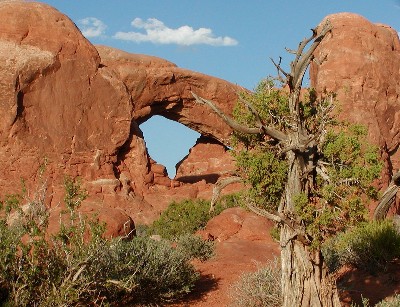
Arches National Park (Utah)

… was redesignated from national monument to national park on this date in 1971.

Arches

For there is a cloud on my horizon. A small dark cloud no bigger than my hand. Its name is Progress.

The ease and relative freedom of this lovely job at Arches follow from the comparative absence of the motorized tourists, who stay away by the millions. And they stay away because of the unpaved entrance road, the unflushable toilets in the campgrounds, and the fact that most of them have never even heard of Arches National Monument.

The Master Plan has been fulfilled. Where once a few adventurous people came on weekends to camp for a night or two and enjoy a taste of the primitive and remote, you will now find serpentine streams of baroque automobiles pouring in and out, all through the spring and summer, in numbers that would have seemed fantastic when I worked there: from 3,000 to 30,000 to 300,000 per year, the “visitation,” as they call it, mounts ever upward [769,672 visitors in 2003].

Progress has come at last to Arches, after a million years of neglect. Industrial Tourism has arrived.

— Edward Abbey, Desert Solitaire (1968)

NewMexiKen photo, 2003

How Big are the States in America?

The 50 states that make up the United States have drastically different sizes. The largest state, Alaska, for example is about 425 times bigger than the smallest, Rhode Island. The three largest states, Alaska, Texas and California make up about 30% of the entire country!

It is also interesting to note that due to sea erosion, the states along the coasts are slowly shrinking in size with one exception – Hawaii. Due to volcanic activity, Hawaii is actually increasing in size; Kilauea Volcano has been erupting since 1983 and has added almost one square mile of new land to the state since then.

The above from the Wise Geek, which has an interesting chart.

Carlsbad Caverns National Park (New Mexico)

Eight-four years ago today President Calvin Coolidge signed a proclamation creating Carlsbad Cave National Monument and its “extraordinary proportions and… unusual beauty and variety of natural decoration…” It became a national park in 1930.

Carlsbad Caverns

As you pass through the Chihuahuan Desert and Guadalupe Mountains of southeastern New Mexico and west Texas—filled with prickly pear, chollas, sotols and agaves—you might never guess there are more than 300 known caves beneath the surface. The park contains 113 of these caves, formed when sulfuric acid dissolved the surrounding limestone, creating some of the largest caves in North America.

Carlsbad Caverns National Park (U.S. National Park Service)

Clutter

Ask the pilot’s Patrick Smith answers some questions, but first gets off on a little rant. Here’s an excerpt:

There are lots of things to dislike about hotel rooms: temperamental air conditioning, ugly carpeting, toe-breaking doorjambs. Here’s another one: cardboard brochures. Nowadays, every hotel amenity, from room service to Wi-Fi, is hawked through one or more annoying cardboard advertisements displayed throughout the room. …

My favorites are the signs boasting of the hotel’s dedication to the environment.

Wolf Trap National Park for the Performing Arts

… was authorized on this date in 1966.

Wolf Trap Farm Park

Wolf Trap National Park for the Performing Arts began as a gift to the American people from Catherine Filene Shouse. Encroaching roads and suburbs inspired Mrs. Shouse to preserve this former farm as a park. In 1966 Congress accepted Mrs. Shouse’s gift and authorized Wolf Trap Farm Park (its original name) as the first national park for the performing arts. Through a fruitful partnership between the National Park Service and the Wolf Trap Foundation, Wolf Trap National Park for the Performing Arts offers a wealth of natural and cultural resources to the community and to the nation.

National Park Service

NewMexiKen and family once upon a time lived in one of the encroaching suburbs just down the street from Wolf Trap Farm Park.

A theater of the absurd

Ask the pilot writes about security. It’s all good I thought, but particularly this:

If the rules themselves aren’t crazy enough, the physical setup of the screening stations is atrocious. After all this time, they remain a jury-rigged assemblage of noise, clutter and disorganization. A couple of particulars: Why are the X-ray platforms at waist level, requiring people to lift their heavy bags on and off? How difficult would it be to have an incline on the front end, and a carousel of sorts on the back end, allowing passengers to collect their belongings in an orderly fashion. The typical pickup point — a cluster of flailing arms and the dangerous slinging of heavy bags — reminds me of the mosh pits of the early 1980s (we called it “slam dancing” in those days, but you get the idea).

At this point, the whole apparatus of concourse security is little more than a stage presentation, a theater of the absurd, choreographed to the cowardly notion that confiscating shampoo bottles and forcing airline captains to remove their footwear actually makes us safer. How we got here is an interesting study in reactionary politics, fear-mongering, and a disconcerting willingness of the American public to accept almost anything in the name of “security.” We have come to equate intrusiveness and inconvenience with safety.

America’s Wild Legacy

All across America, communities are working to protect our public lands from threats like oil and gas drilling, unchecked development, irresponsible recreation, logging, and global warming. In order to save what remains of our nation’s wild legacy, the Sierra Club has launched a campaign to protect fifty-two of our most exceptional places–one in every state, plus Puerto Rico and the District of Columbia–over the next ten years.

52 Places Report

Follow the link to read about the places — and to download a Google Earth file that lets you see each of the 52.

Yosemite National Park

… was established on this date in 1890.

Yosemite Valley

NewMexiKen photo, 2005.
Click for larger version.

Not just a great Valley…

but a shrine to human foresight, strength of granite, power of glaciers, the persistence of life, and the tranquility of the High Sierra.

Yosemite National Park, one of the first wilderness parks in the United States, is best known for its waterfalls, but within its nearly 1,200 square miles, you can find deep valleys, grand meadows, ancient giant sequoias, a vast wilderness area, and much more.

Yosemite National Park

Rock Creek Park (District of Columbia)

Rock Creek Park was authorized on this date in 1890.

Rock Creek Park

Rock Creek Park is truly a gem in our nation’s capital. It offers visitors an opportunity to reflect and soothe their spirits through the beauty of nature. Fresh air, majestic trees, wild animals, and the ebb and flow of Rock Creek emanate the delicate aura of the forest.

U.S. National Park Service

America’s First National Monument

President Theodore Roosevelt proclaimed Devils Tower a national monument 101 years ago today. It was the first landmark set aside under the Antiquities Act.

Devil's Tower

The nearly vertical monolith known as Devils Tower rises 1,267 feet above the meandering Belle Fourche River. Once hidden below the earth’s surface, erosion has stripped away the softer rock layers revealing Devils Tower.

Known by several northern plains tribes as Bears Lodge, it is a sacred site of worship for many American Indians. The rolling hills of this 1,347 acre park are covered with pine forests, deciduous woodlands, and prairie grasslands. Deer, prairie dogs, and other wildlife are abundant.

Source: National Park Service

NewMexiKen, who has circumnavigated Devils Tower, thinks it should be renamed Bears Lodge.

Roosevelt added several more monuments after Devils Tower, including El Morro, Montezuma Castle, Petrified Forest, and Chaco Canyon within the first year of the Act.

No National Park Entrance Fees Saturday

All National Park Service sites will offer free visitor admission on September 29 for National Public Lands Day.

In addition to waiving entrance fees, national parks and other public lands will host special programs and volunteer work parties to commemorate the 14th annual event. Anyone who volunteers at a National Park Service area on National Public Lands Day will receive a free one day pass valid for future use at any site.

National Park Service

The Chesapeake & Ohio Canal

… was acquired from the B&O Railroad on this date in 1938. The property became a National Historical Park in 1971. According to the National Park Service:

Great Falls

The C&O Canal follows the route of the Potomac River for 184.5 miles from Washington, D.C. to Cumberland, MD. The canal operated from 1828-1924 as a transportation route, primarily hauling coal from western Maryland to the port of Georgetown in Washington, D.C. Hundreds of original structures, including locks, lockhouses, and aqueducts, serve as reminders of the canal’s role as a transportation system during the Canal Era. In addition, the canal’s towpath provides a nearly level, continuous trail through the spectacular scenery of the Potomac River Valley.

Fort Caroline National Memorial (Florida)

… was authorized on this date in 1950. According to the National Park Service:

Fort Caroline

Fort Caroline National Memorial was created to memorialize the Sixteenth Century French effort to establish a permanent colony in Florida. After initial exploration in 1562, the French established “la Caroline” in June 1564. Spanish forces arrived 15 months later. Marching north from their newly established beachhead (San Agustin) the Spanish captured la Caroline in September, 1565. Nothing remains of the original Fort de la Caroline; a near full-scale rendering of the fort, together with exhibits in the visitor center, provide information on the history of the French colony, their interaction with the native Timucua, and the colonists’ brief struggle for survival.

Whoa! You mean the French and Spanish were here even before the English at Jamestown and Plymouth Rock?

Assateague Island National Seashore (Maryland & Virginia)

… was established on this date 42 years ago. The National Park Service tells us:

Assateague Island

Storm tossed seas, as well as gentle breezes shape Assateague Island. This barrier island is a tale of constant movement and change.

Bands of wild horses freely roam amongst plants and native animals that have adapted to a life of sand, salt and wind. Special thickened leaves and odd shapes reveal the plant world’s successful struggle here. Ghost crabs buried in the cool beach sand and tree swallows plucking bayberries on their southward migration offer glimpses of the animal world’s connection to Assateague.

Assateague’s wild horses are well known, even to many people who have never been to the island. The “wild” horses on Assateague are actually feral animals, meaning that they are descendants of domestic animals that have reverted to a wild state. Horses tough enough to survive the scorching heat, abundant mosquitoes, stormy weather and poor quality food found on this remote, windswept barrier island have formed a unique wild horse society.

Read more about Assateague’s Wild Horses.