The Congress of the United States abolished the slave trade in the District of Columbia on this date in 1850 as part of the so-called Compromise of 1850.
Slavery itself continued in the capital of the United States until April 1862.
Brief narratives about people and events in the American past.
The Congress of the United States abolished the slave trade in the District of Columbia on this date in 1850 as part of the so-called Compromise of 1850.
Slavery itself continued in the capital of the United States until April 1862.
On September 17, 1787, the delegates to the Constitutional Convention met for the last time to sign the document and send it to the states for ratification.
We, the people of the United States, in order to form a more perfect union, establish justice, ensure domestic tranquility, provide for the common defence, promote the general welfare, and secure the blessings of liberty to ourselves and our posterity, do ordain and establish this constitution for the United States of America.
“Of all the days on all the fields where American soldiers have fought, the most terrible by almost any measure was September 17, 1862. The battle waged on that date, close by Antietam Creek at Sharpsburg in western Maryland, took a human toll never exceeded on any other single day in the nation’s history. So intense and sustained was the violence, a man recalled, that for a moment in his mind’s eye the very landscape around him turned red.”
Stephen W. Sears
Landscape Turned Red: The Battle of Antietam
The New York Times coverage from 1862 is online.
America’s bloodiest day:
| Killed: | Union 2,000 | Confederate 1,550 | Total Killed: 3,650 |
| Wounded: | Union 9,550 | Confederate 7,750 | Total Wounded: 17,300 |
| Missing/Captured: | Union 750 | Confederate 1,020 | Total Missing: 1,770 |
| Total: | Union 12,400 | Confederate 10,320 | Total Casualties: 22,720 |
As a rule of thumb, about 20% of the wounded died of their wounds and 30% of the missing had been killed (in the days before dog-tags to identify the dead). Accordingly, an estimate of the total dead from the one-day battle: 7,640.
Source: National Park Service
NewMexiKen is reading Mark Katz’s Capturing Sound: How Technology Has Changed Music. It’s a well-regarded book that I am finding interesting, though actually I was looking more for a history of the early recorded music business. Katz’s interest is mostly from the musicologist point of view.
Still, some interesting stuff.
One of the most basic manipulations is splicing, in which passages recorded at different times are joined together. The Beatles’ “Strawberry Fields Forever” (1967) provides a famous example. The Beatles did over two dozen takes of the song, none of which completely satisfied John Lennon. But he did like the first half of Take 7 and the second half of Take 26. So he asked George Martin, their producer, to put the two together. Unfortunately, they were in different keys and tempos. The two takes, however, were related in such a way that when one was sped up and the other slowed down so that the tempos matched, the pitches also matched. Thus the two takes could be joined, the splice occurring at about 0:59 on the word going in “Let me take you down ’cause I’m going to Strawberry Fields.” Although the splice is nearly undetectable, the slightly altered speed of Lennon’s voice helps give the song its distinctively dreamlike quality.
Another passage notes the impact of the Depression and free radio on the phonograph business:
“In 1927, 104 million discs and 987,000 machines were sold; by 1932, the numbers had plummeted to 6 million and 40,000.”
Maybe our present day music industry should quit its whining.
… is the birthday:
… of Milton S. Hershey, born on this date in 1857. Hershey, who only completed the fourth grade, developed a formula for milk chocolate that made what had been a luxury product into the first nationally marketed candy.
… of Sherwood Anderson, born on this date in 1876 in Camden, Ohio.
[Anderson] is best known for his short stories, “brooding Midwest tales” which reveal “their author’s sympathetic insight into the thwarted lives of ordinary people.” Between World War I and World War II, Anderson helped to break down formulaic approaches to writing, influencing a subsequent generation of writers, most notably Ernest Hemingway and William Faulkner. Anderson, who lived in New Orleans for a brief time, befriended Faulkner there in 1924 and encouraged him to write about his home county in Mississippi. (Library of Congress)
… of Bill Monroe, born on this date in 1911. The Father of Bluegrass Music was inducted into the Country Music Hall of Fame in 1970. In 1993, Monroe was a recipient of the Lifetime Achievement Award from the National Academy of Recording Arts and Sciences, an honor that placed him in the company of Louis Armstrong, Ray Charles and Paul McCartney. Monroe died in 1996.
Monroe is also an inductee of the Rock and Roll Hall of Fame:
Musical pioneer Bill Monroe is known as “the father of bluegrass music.” While Monroe would humbly say, “I’m a farmer with a mandolin and a high tenor voice,” he and His Blue Grass Boys essentially created a new musical genre out of the regional stirrings that also led to the birth of such related genres as Western Swing and honky-tonk. From his founding of the original bluegrass band in the Thirties, he refined his craft during six decades of performing. In so doing, he brought a new level of musical sophistication to what had previously been dismissed as “rural music.” Both as ensemble players and as soloists, Monroe and his Blue Grass Boys upped the ante in their chosen genre much the way Duke Ellington’s and Miles Davis’s bands did in jazz. Moreover, the tight, rhythmic drive of Monroe’s string bands helped clear a path for rock and roll in the Fifties. That connection became clear when a reworked song of Monroe’s, “Blue Moon of Kentucky,” became part of rock and roll history as the B side of Elvis Presley’s first single for Sun Records in 1954. Carl Perkins claimed that the first words Presley spoke to him were, “Do you like Bill Monroe?”
… of Mel Torme, born on this date in 1925. The “Velvet Fog” was a wonderful jazz singer, but his greatest legacy is writing “The Christmas Song” — “Chestnuts roasting on an open fire…”. Torme died in 1999.
And it’s the anniversary of the inspiration for our most famous song:
As the evening of September 13, 1814, approached, Francis Scott Key, a young lawyer who had come to negotiate the release of an American friend, was detained in Baltimore harbor on board a British vessel. Throughout the night and into the early hours of the next morning, Key watched as the British bombed nearby Fort McHenry with military rockets. As dawn broke, he was amazed to find the Stars and Stripes, tattered but intact, still flying above Fort McHenry.
…Key’s experience during the bombardment of Fort McHenry inspired him to pen the words to “The Star-Spangled Banner.” He adapted his lyrics to the tune of a popular drinking song, “To Anacreon in Heaven,” and the song soon became the de facto national anthem of the United States of America, though Congress did not officially recognize it as such until 1931.
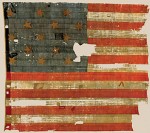
The Smithsonian Institution, which has the original “star-spangled banner,” has details about the flag.
Supreme Court justice Oliver Wendell Holmes Jr. shook hands with both John Quincy Adams (who had been the sixth president of the U.S.) and John F. Kennedy (who became the 35th).
Holmes, who was seriously wounded in the Civil War, served on the Court from 1902-1932. He was born in 1841 and died in 1935.
Mentioned by Roger Angell in last week’s New Yorker.

Poynter.org has a gallery of front pages from September 11 and 12, 2001.
According to an item at The Writer’s Almanac last year:
It was on this day in 30 BC that Queen Cleopatra of Egypt killed herself with a snake she had smuggled into her chamber where she was held captive by Octavian, formerly the political rival of her lover Mark Antony. Octavian had defeated Cleopatra and Antony at the Battle of Actium and had taken Cleopatra prisoner. When Cleopatra learned that Octavian planned to parade her as part of his triumphant return to Rome, she planned her own suicide. For centuries, it was assumed that the snake she used was an asp, but it is now thought that the snake was an Egyptian cobra.
Other sources say it was August 12, not August 30, so I guess those Writer’s Almanac folks got 30 BC and August 30 mixed up. Whatever.
Cleopatra was Greek, the last queen of Ptolemaic Egypt. When she was 17-18, Cleopatra and her 12-year-old brother/husband inherited the throne from their father. They fought over who was really the ruler, with Ptolemy XIII emerging as victor until Julius Caesar showed up. And the rest, as they say, was history.
Cleo was the mother of four children, one with Julius Gaius Caesar (31 years her senior) and three with Mark Antony (14 years her senior). Cleopatra was 39 when she died.
The conclusion of Martin Luther King Jr.’s speech in Washington 43 years ago today.
I have a dream that one day this nation will rise up and live out the true meaning of its creed: We hold these truths to be self-evident that all men are created equal.
I have a dream that one day on the red hills of Georgia the sons of former slaves and the sons of former slave owners will be able to sit down together at the table of brotherhood.
I have a dream that one day even the state of Mississippi, a state sweltering with the heat of injustice, sweltering with the heat of oppression, will be transformed into an oasis of freedom and justice.
I have a dream that my four little children will one day live in a nation where they will not be judged by the color of their skin but by the content of their character. I have a dream today!
I have a dream that one day, down in Alabama, with its vicious racists, with its governor having his lips dripping with the words of interposition and nullification; one day right down in Alabama little black boys and black girls will be able to join hands with little white boys and white girls as sisters and brothers. I have a dream today!
I have a dream that one day every valley shall be exalted, and every hill and mountain shall be made low, the rough places will be made plain, and the crooked places will be made straight, and the glory of the Lord shall be revealed and all flesh shall see it together.
This is our hope. This is the faith that I will go back to the South with. With this faith we will be able to hew out of the mountain of despair a stone of hope. With this faith we will be able to transform the jangling discords of our nation into a beautiful symphony of brotherhood. With this faith we will be able to work together, to pray together, to struggle together, to go to jail together, to stand up for freedom together, knowing that we will be free one day. And this will be the day, this will be the day when all of God’s children will be able to sing with new meaning, “My country ’tis of thee, sweet land of liberty, of thee I sing. Land where my fathers died, land of the Pilgrim’s pride, from every mountainside, let freedom ring!” And if America is to be a great nation, this must become true.
And so let freedom ring — from the prodigious hilltops of New Hampshire.
Let freedom ring — from the mighty mountains of New York.
Let freedom ring — from the heightening Alleghenies of
Pennsylvania.Let freedom ring — from the snow-capped Rockies of Colorado.
Let freedom ring — from the curvaceous slopes of California.
But not only that.
Let freedom ring — from Stone Mountain of Georgia.
Let freedom ring — from Lookout Mountain of Tennessee.
Let freedom ring — from every hill and molehill of Mississippi,
from every mountainside, let freedom ring!And when this happens, when we allow freedom to ring, when we let it ring from every village and every hamlet, from every state and every city, we will be able to speed up that day when all of God’s children, black men and white men, Jews and Gentiles, Protestants and Catholics, will be able to join hands and sing in the words of the old Negro spiritual,
“Free at last, free at last.
Thank God Almighty, we are free at last.”
Jill, oldest daughter of NewMexiKen, sent along these photos taken yesterday at a reenactment at Manassas National Battlefield Park.


The Second Battle at Manassas was fought on August 29-30, 1862.
Click each image to see larger version.
Ken Jennings has a really fascinating U.S. history/culture trivia quiz based on the U.S. Capitol’s Statuary Hall.
On August 23, 1864, the Union navy captured Fort Morgan, Alabama, breaking the Confederate dominance of the ports of the Gulf of Mexico. As the Union fleet of four ironclad and fourteen wooden ships sailed into the channel on August 5, one of the lead ships, the Tecumseh, hit a mine, at the time known as a “torpedo.”
In reply to the warning, “Torpedoes ahead!” given by the forward ships, commander Admiral David Farragut called out, “Damn the torpedoes!” and, taking the lead with his flagship the Hartford, sailed over the double row of mines and into Mobile Bay.
Although the bottom of the ship scraped the mines, none exploded, and the rest of the fleet followed Farragut’s flagship to victory in the engagement with the Confederate flotilla. During the next weeks, the Union navy consolidated its hold on the bay by dispersing and capturing Southern ships and tightening the blockade. With the surrender of Fort Morgan, the Union was able to cut the South off from its overseas supply routes.
“I may be the only person, the only presidential candidate who never carried the state in which he was born.”
President Bush, Monday. He was born in Connecticut.
Actually, as reported in today’s New York Times, there are quite a few including his own father and both of his opponents, Gore and Kerry. Oh, and Lincoln. And more.
On this date in 1680, the surviving Spanish settlers under siege decided to abandon Santa Fe and began the trek to Chihuahua. The Spanish did not return to New Mexico for 12 years.
Colonists from Mexico first settled in New Mexico, north of present-day Santa Fe, in 1598. By the 1620s there were 2,000 colonists taking land and forcing labor from the Puebloans, occasionally executing dozens of Indians for the murder of one settler. In the 1660s a drought further stressed conditions for all, especially as Apaches and others raided the Pueblos. Many Puebloans began to feel that deserting their own religion to accept Christianity had brought on these disasters. There were occasional uprisings, but nothing sustainable until Popé, a San Juan medicine man, began unifying resistance among the various independent Pueblos in 1675.
On August 10, 1680, the Indians launched a unified all-out attack on Spanish settlers. Colonists were killed, churches burned, horses and cattle seized. Priests were singled out and killed in all the Pueblos, including Acoma, Zuni and Hopi (in modern Arizona). About 1,000 survivors escaped to Santa Fe and the town was put under siege on August 12. By the 16th the Indians occupied all of the town except the plaza and its surrounding buildings. According to reports, as they burnt the town the Indians sang Latin liturgy to taunt the Spanish.
Three-hundred-and-twenty-six years ago today the settlers were allowed to withdraw from Santa Fe. When they reached El Paseo del Norte in October, there were 1,946 from of a population that had been about 2,500. About 400 had been killed, another 150 escaped to Mexico independently.
The Puebloans removed all signs of the Spanish — the churches, the religion itself, the crops, even the animals (the horses let loose on the plains, eventually transforming the culture of the Plains Indians). One vestige remained: one man rule. Popé declared himself that man and moved to the Palace in Santa Fe.
Spanish attempts at reconquest failed until 1692.
“A hundred and seventy-five years ago today, a 30-year-old black slave named Nat Turner, supported by about 60 followers armed with guns, clubs, axes and swords, launched the bloodiest slave revolt in American history.”
Joshua Zeitz has more on the revolt, its context, aftermath and legacy at AmericanHeritage.com.
Earlier NewMexiKen discussed the 160th anniversary today of New Mexico’s conquest by the United States. Taking New Mexico from Mexico wasn’t too difficult (though it was part of a larger hard fought war). Taking New Mexico from Texas was another story.
 Declaring its independence in 1836, Texas claimed the Rio Grande as its boundary from the Gulf of Mexico to the source in the San Juan Mountains of Colorado. [Map courtesy Wikipedia.] Even after it became a state in 1845, and even after New Mexico came under control of the U.S. Army in 1846, Texas maintained its claim. The Texas legislature in 1848 established Santa Fe County to include most of the disputed area.
Much of the seriousness of the contention over the land centered on slavery. If part of Texas, slavery would be permitted. If in New Mexico, probably not.
Matters worsened in late June [1850] when word arrived that a small convention in New Mexico had drafted and won ratification of a free-state constitution. [President] Taylor immediately called for New Mexico’s admission along with California’s; southern outrage flared to new heights; and the state of Texas vowed to secure its claims to all of New Mexico east of the Rio Grande, by force if necessary. Taylor ordered the federal garrison at Santa Fe to prepare for combat. By early July, it looked as if civil war might break out, pitting the United States against southern volunteers determined to secure greater Texas for slavery. (The Rise of American Democracy)
Taylor died July 9. Fillmore became president and defused the situation by laying aside New Mexico’s application for statehood. (If Taylor hadn’t gotten gastroenteritis New Mexico could have become a state 62 years sooner!) The resolution came as part of the Compromise of 1850. The boundaries of Texas were established as we know them (poor surveying and meandering rivers notwithstanding). In return, Texas received $10 million in compensation applied toward its debt (worth about $200 million today). The bill also established the territories of New Mexico (which included present-day Arizona) and Utah (which included present-day Nevada and western Colorado). The issue of slavery in those territories was ignored — for then.
Before August 17, 1896, Americans had little interest in Alaska, a far off “district”—not even a territory—full of wolves and ice and forests. That attitude started to change 110 years ago today, when a Tagish Indian known as Skookum Jim spotted something shimmering among the stones in a creek near the Yukon River. The Klondike Gold Rush began as soon as news of the discovery reached the states, and between 1897 and 1899 1 in every 700 Americans abandoned home and set out for the “Golden River.”
More than a half million pounds of gold have been found in the Yukon since 1896. Yet the story of the men and women who did the mining is more valuable than all that ore. The sudden rush into the Northwest, as well as the equally sudden retreat, poses a big question. Why did so many late-nineteenth-century Americans decide to leave their farms and factories and search for gold in a faraway, brutal, and alien place?
There’s more if you click on the link, including this nugget: “At a time when workers were lucky to make 10 cents an hour, gold was worth $17 an ounce.”
… was authorized on this date in 1990.
The national trail commemorates the route followed by a Spanish commander, Juan Bautista de Anza, in 1775-76 when he led a contingent of 30 soldiers and their families to found a presidio and mission near the San Francisco Bay. Along the trail route, the visitor can experience the varied landscapes similar to those the expedition saw; learn the stories of the expedition, its members, and descendants; better understand the American Indian role in the expedition and the diversity of their cultures; and appreciate the extent of the effects of Spanish colonial settlement of Arizona and California.
Over 240 people set out from Tubac on October 23, 1775. The first night out, the group suffered its only death en route when María Manuela Piñuelas died from complications after childbirth. Her son lived. Two other babies born on the trip brought the total number of settlers to 198. Of these, over half were children 12 years old and under.
The expedition continued down the Santa Cruz River to its junction with the Gila River. While they camped, Anza, Font, and a few soldiers visited Casa Grande, which was already known as an ancient Indian site. They followed the Gila to the Colorado River crossing, one birth occuring along the way. They were assisted in crossing the Colorado by Olleyquotequiebe (Salvador Palma), chief of the Yumas (Quechan), whose tribe had befriended Anza on his 1774 trek.
As the route headed through the sand dunes and deserts of southeastern California, the journey became more difficult. To better secure forage and water during one of the coldest winters on record, Anza divided the expedition into three groups, each traveling a day apart to allow water holes to refill.
They regrouped near what is now Anza Borrego Desert State Park. On Christmas Eve they welcomed another birth and reached Mission San Gabriel Arcángel on January 4, 1776. From there they followed known trails through Indian villages along the coast of California, visiting Mission San Luís Obispo de Toloso and San Antonio de Padúa, to arrive at Monterey and nearby mission San Carlos Borromeo de Carmelo on March 10.
Anza then took a small group to explore San Francisco Bay, where he chose sites for the presidio and the mission. Following orders to explore the “River of Saint Francis,” he traveled the east side of San Francisco Bay before turning south to return to Monterey.
… was born on this date in 1874. Mr. Hoover, who was the 31st President of the United States, lived until 1964. Among the presidents, only Reagan, Ford and the first Adams have lived longer.
Born in Iowa, orphaned at nine, Hoover grew up in Oregon. He was in the first class at Stanford University, graduating as a mining engineer. Hoover earned millions in mining before turning his attention to public service. He was instrumental in relief and humanitarian efforts during and after World War I. He was Secretary of Commerce under Presidents Harding and Coolidge.
Hoover, the Republican, defeated Al Smith, the Democrat, handily in the 1928 election with 58% of the popular vote.
President at the time of the stock market crash and subsequent depression, Hoover believed that, while people should not suffer, assistance should be primarily a local and voluntary responsibility. Even so, he supported some measures to aid businesses and farmers; indeed, among his party he was moderate. But he was simply not bold enough to meet the crisis.
Hoover lost to Franklin Roosevelt in 1932, 57.3% to 39.6% of the popular vote, 472-59 in the electoral vote.
Click to hear a sound bite from this date in history (1974) [33k WAV file].
Neil Armstrong is 76 today.
Armstrong was first. How many others have walked on the moon?
All you current and former civil servants out there should find Armstrong to be your particular hero. The first man on the moon was a federal employee, a GS-14.
… was found dead on this date in 1962. She was 36.
According to Joe DiMaggio biographer Richard Ben Cramer, after Monroe’s marriage to Arthur Miller had ended, she and DiMaggio had reconciled — the Kennedys notwithstanding. By 1962 they planned to re-marry. The wedding was set for Wednesday, August 8, 1962. Very private, very hush-hush.
Five days before the wedding date, on Saturday night, August 3, Marilyn died, a presumed suicide. (According to Cramer, no coroner’s inquest was held.) Marilyn Monroe’s funeral was August 8, 1962.
NewMexiKen posted an entry on the cause of Marilyn and Joe’s initial break in January 2004.
Of course, Bobby Kennedy was in Los Angeles at the time of Marilyn’s death, so maybe …
It always bugs me when I hear someone say that the Baby Ruth candy bar was named for baseball player Babe Ruth. Ignorance! The bar was named for Ruth Cleveland, the daughter of President Grover Cleveland.
Or was it?
The Baby Ruth bar was introduced by the Curtiss Candy Company in 1920. The company claimed that the bar was named for Ruth Cleveland. But she had had died 16 years before, and her father had long ago left the White House.
Why would anyone name a candy bar after the long-dead daughter of an ex-president? Maybe because they hadn’t negotiated a royalties deal with an up-and-coming baseball star. The company’s explanation seems fishy, but it passed legal muster in the 1920s.
[Another post from Jill. She’s getting good at this, I may take a vacation. Ruth had a great year in 1920, his first with the New York Yankees. He hit an unbelievable 54 home runs and batted .376.]
Nora Ephron, who is 65, has posted a number of one-liners of things she wishes she had known as she grew older — and wiser. There are a few gems among them.
Elsewhere, Josh Marshall, after two decades of PCs, and a bad experience with Gateway, likes his Mac.
The Professional Air Traffic Controllers Organization (PATCO) walked off their jobs with the Federal Aviation Administration 25 years ago today. President Reagan threatened to fire the controllers if they didn’t return within 48 hours. Other unions failed to support PATCO. And so began the end of the labor movement in the United States.
… was born on this date in 1900. Until he was killed by enemy fire in April 1945, Pyle “blogged” World War II for millions of Americans.
From The New York Times obituary.
Ernie Pyle was haunted all his life by an obsession. He said over and over again, “I suffer agony in anticipation of meeting people for fear they won’t like me.”
No man could have been less justified in such a fear. Word of Pyle’s death started tears in the eyes of millions, from the White House to the poorest dwellings in the country.
President Truman and Mrs. Eleanor Roosevelt followed his writings as avidly as any farmer’s wife or city tenement mother with sons in service.
Mrs. Roosevelt once wrote in her column “I have read everything he has sent from overseas,” and recommended his writings to all Americans.
For three years these writings had entered some 14,000,000 homes almost as personal letters from the front. Soldiers’ kin prayed for Ernie Pyle as they prayed for their own sons.
NewMexiKen has before posted this quote from Pyle, but why not do so again on his birthday, and because there’s no place like home.
Yes, there are lots of nice places in the world. I could live with considerable pleasure in the Pacific Northwest, or in New England, on the Mississippi Gulf Coast, or in Key West or California or Honolulu. But there is only one of me, and I can’t live in all those places. So if we can have only one house — and that’s all we want — then it has to be in New Mexico, and preferably right at the edge of Albuquerque where it is now. Ernie Pyle, January 1942
Pyle’s home on Girard SE is now a branch of the Albuquerque/Bernalillo County Library System.