November 2nd is the birthday

… of James Knox Polk, 11th president of the United States, born on this date in 1795.

… of Warren Gamaliel Harding, 29th president of the United States, born on this date in 1865.

Polk is generally rated among the “near great” presidents. Harding who died while president, is generally considered a “failure,” though he has moved up the ratings at least one slot during the past seven years.

k.d. lang is 46 today. David Schwimmer — “Ross” — is 41.

Burt Lancaster was born on November 2, 1913. Lancaster had four best actor Oscar nominations, winning for Elmer Gantry. Among his last performances was as Dr. Archibald “Moonlight” Graham in Field of Dreams. Lancaster died in 1994.

October 22nd

Three time best actress Oscar nominee Joan Fontaine is 90 today. Miss Fontaine won the Oscar in 1942 for Suspicion. Good genes in that family. Her sister Olivia de Havilland turned 91 in July.

Nobel Prize-winner Doris Lessing is 88 today.

“that epicist of the female experience, who with scepticism, fire and visionary power has subjected a divided civilisation to scrutiny”

Nobel Prize for Literature 2007

Christopher Lloyd is 69.

Annette Funicello is 65.

Catherine Deneuve is 64.

Jeff Goldblum is 55.

It was on this date in 1962, that President Kennedy told the nation about the Soviet missiles in Cuba. From The New York Times report on the speech:

President Kennedy imposed a naval and air “quarantine” tonight on the shipment of offensive military equipment to Cuba.

In a speech of extraordinary gravity, he told the American people that the Soviet Union, contrary to promises, was building offensive missiles and bomber bases in Cuba. He said the bases could handle missiles carrying nuclear warheads up to 2,000 miles.

Thus a critical moment in the cold war was at hand tonight. The President had decided on a direct confrontation with–and challenge to–the power of the Soviet Union.

*****

All this the President recited in an 18-minute radio and television address of a grimness unparalleled in recent times. He read the words rapidly, with little emotion, until he came to the peroration–a warning to Americans of the dangers ahead.

“Let no one doubt that this is a difficult and dangerous effort on which we have set out,” the President said. “No one can foresee precisely what course it will take or what costs or casualties will be incurred.”

“The path we have chosen for the present is full of hazards, as all paths are–but it is the one most consistent with our character and courage as a nation and our commitments around the world,” he added.

It was as close as we’ve ever come to nuclear war.

NewMexiKen thought Ted Sorensen’s talk on the Cuban missile crisis and the rule of law earlier this year was quite interesting. It’s available from Yale via iTunes as a free 45-minute podcast.

Our founders

In the sixty-two years between Washington’s election and the Compromise of 1850, for example, slaveholders controlled the presidency for fifty years, the Speaker’s chair for forty-one years, and the chairmanship of House Ways and Means [the most important committee] for forty-two years. The only men to be reelected president —Washington, Jefferson, Madison, Monroe, and Jackson—were all slaveholders. The men who sat in the Speaker’s chair the longest—Henry Clay, Andrew Stevenson, and Nathaniel Macon—were slaveholders. Eighteen out of thirty-one Supreme Court justices were slaveholders.

Historian Leonard Richards quoted by Garry Wills

October 16th

Angela Lansbury is 82 today. Lansbury was 36 when she played 34-year-old Laurence Harvey’s mother in The Manchurian Candidate. For that alone she deserved the Academy Award nomination she received; it was her third supporting actress nomination.

Suzanne Somers turns 61 today. (No NewMexiKen’s kids, you’re still not allowed to watch Three’s Company.)

Tim Robbins is 49 today. Robbins won a supporting actor Oscar for Mystic River and received a best director nomination for Dead Man Walking. Hard to beat his portrayal of Andy Dufresne, though.

John Mayer is 30 today.

Nobel and Pulitizer Prize winner Eugene O’Neill was born on October 16th in 1888.

Eugene O’Neill was one of the greatest playwrights in American history. Through his experimental and emotionally probing dramas, he addressed the difficulties of human society with a deep psychological complexity. O’Neill’s disdain for the commercial realities of the theater world he was born into led him to produce works of importance and integrity.

American Masters

John Brown began his famous raid on this date in 1859:

Late on the night of October 16, 1859, John Brown and twenty-one armed followers stole into the town of Harper’s Ferry, Virginia (now West Virginia) as most of its residents slept. The men–among them three free blacks, one freed slave, and one fugitive slave–hoped to spark a rebellion of freed slaves and to lead an “army of emancipation” to overturn the institution of slavery by force. To these ends the insurgents took some sixty prominent locals including Col. Lewis Washington (great-grand nephew of George Washington) as hostages and seized the town’s United States arsenal and its rifle works.

The upper hand which nighttime surprise had afforded the raiders quickly eroded, and by the evening of October 17, the conspirators who were still alive were holed-up in an engine house. In order to be able to distinguish between insurgents and hostages, marines under Colonel Robert E. Lee waited for daylight on October 18 to storm the building.

Library of Congress

Marie Antoinette’s head became estranged from the rest of her body on this date in 1793.

October 13th is also

… the birthday of the White House.

The cornerstone of the White House was laid on October 13, 1792. President John Adams and his wife Abigail moved into the unfinished structure on November 1, 1800, keeping to the scheduled relocation of the capital from Philadelphia. Congress declared the city of Washington in the District of Columbia the permanent capital of the United States on July 16, 1790. …

Constructed of white-grey sandstone that contrasted sharply with the red brick used in nearby buildings, the presidential mansion was called the White House as early as 1809. President Theodore Roosevelt officially adopted the term in 1902.

Source: Library of Congress

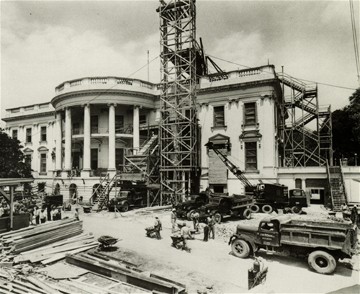
During the Truman Administration the White House was gutted except for the outside walls and rebuilt. This photo was taken in April 1950.

White House Construction

Gutted to the outside stone walls, deepened with a new two story basement, reinforced with concrete and 660 tons of steel, and fireproofed, the White House was stabilized. The protection of the historic stone walls was so important that workers dismantled a bulldozer and reassembled it inside to avoid cutting a larger doorway out of the walls. Shafts out of windows carried out debris from the inside of the house, and external stairs were built because the inside was completely empty during the renovation.

Source: The White House Historical Association

The Truman Presidential Museum and Library has a photo essay on the reconstruction — The White House Revealed — though the photos are too small to view much detail.

Stand and deliver

Today marks the anniversary of the first American train robbery. An east bound Ohio & Mississippi passenger train was boarded by the Reno brothers near Seymour, Indiana, on this date in 1866.

The Today in History page at the Library of Congress provides background about train robberies and early railroads including this excerpt from “The Early Days in Silver City” —

I happened to be riding that train. I had gone overland to Safford and Solemisvelle prospecting. I decided to come home Thanksgiving to be with my family at Silver City. I boarded the train at Wilcox. There was a large shipment of gold on the train. Just out of Steins Pass we could see a large bon-fire. One of the trainmen remarked, ‘Wonder what the big fire is, I hope we don’t run into any trouble.’ The bon-fire we discovered to our sorrow was on the R. R. Then as today curiosity got the best of some of us so we had to find out why the train came to an abrupt stop, and what the bon-fire was put on the track. We found ourselves looking into the barrel of guns.

You can be sure

… if it’s Westinghouse.

George Westinghouse was born on this date in 1846 in Central Bridge, New York.

In 1869, Westinghouse received a patent for the air brake, which permitted the locomotive engineer to apply the brakes equally to all cars. Previously brakemen had applied the brakes manually and accidents were common. The invention was adopted by most railroads worldwide.

In 1884, Westinghouse formed Westinghouse Electric and acquired Nikola Tesla’s patents for alternating current. He was opposed by Thomas Edison whose own company (General Electric) fostered direct current. Ultimately, of course, alternating current (and Westinghouse) emerged victorious, but not before one of the more gruesome battles in industrial competion. The following is from the Kirkus review of Executioner’s Current: Thomas Edison, George Westinghouse, and the Invention of the Electric Chair:

Enron and Worldcom executives take heart: this grim account of the origins of execution by electrocution proves that business-based sleaze can go a lot further than accounting fraud. As Moran (Sociology/Mount Holyoke Coll.) shows, the Edison Electric Co., with Thomas A. himself at the helm, relentlessly lobbied the State of New York in 1890 to establish electrocution as the preferred “humane” disposal of those given the death penalty. What actually motivated Edison, despite his professed opposition to capital punishment, was his rivalry with the Westinghouse Company for the vast US market for electrical lighting and power. Edison equipment generated only direct current (DC), but the tide was turning towards the Westinghouse alternative, AC power. Each side claimed that the other had serious safety deficiencies. By persuading authorities to adopt alternating current for the death chair, Edison and his minions hoped to foster a public image of AC as the truly “lethal” form of electricity. Moran spares readers no details of the gruesomely botched first electrocution at Auburn Prison in August 1890, during which convicted murderer William Kemmler was seen by some witnesses to “suffer horribly,” as current from the Westinghouse dynamo (purchased under false pretenses) was shut off twice while attending doctors pondered the presence of respiration and heartbeat, then switched on again. Its proponents, however, continued to endorse electrocution as a best-case method (absent the bungling at Auburn) while the debate continued over decades. The author points out that we still don’t know exactly how electricity kills a human being (cardiac arrest being the prime suspect), and survivors of serious accidental shocks do report varieties of excruciating pain.

Westinghouse opposed the execution, of course, and even helped fund Kemmler’s appeals, but Westinghouse’s money was no match for Edison’s celebrity.

I will fight no more forever

With 2,000 U.S. soldiers in pursuit, Chief Joseph led fewer than 300 Nez Percé Indians towards freedom at the Canadian border. For over three months, the Nez Percé outmaneuvered and battled their pursuers traveling over 1,000 miles across Oregon, Washington, Idaho, and Montana. On October 5, 1877, Chief Joseph, exhausted and disheartened, surrendered in the Bear Paw mountains of Montana, 40 miles south of Canada.

Library of Congress

Surrendering to Gen. Nelson Miles 130 years ago today, Joseph spoke:

I am tired of fighting. Our Chiefs are killed; Looking Glass is dead, Ta Hool Hool Shute is dead. The old men are all dead. It is the young men who say “Yes” or “No.” He who led the young men is dead. It is cold, and we have no blankets; the little children are freezing to death. My people, some of them, have run away to the hills, and have no blankets, no food. No one knows where they are – perhaps freezing to death. I want to have time to look for my children, and see how many of them I can find. Maybe I shall find them among the dead. Hear me, my chiefs! I am tired. My heart is sick and sad. From where the sun now stands, I will fight no more forever.

Timely analysis from 1776

The more things change, the more they stay the same. Glenn Greenwald quotes Adam Smith from Wealth of Nations:

The ordinary expense of the greater part of modern governments in time of peace being equal or nearly equal to their ordinary revenue, when war comes they are both unwilling and unable to increase their revenue in proportion to the increase of their expense. They are unwilling for fear of offending the people, who, by so great and so sudden an increase of taxes, would soon be disgusted with the war; and they are unable from not well knowing what taxes would be sufficient to produce the revenue wanted.

The facility of borrowing delivers them from the embarrassment which this fear and inability would otherwise occasion. By means of borrowing they are enabled, with a very moderate increase of taxes, to raise, from year to year, money sufficient for carrying on the war, and by the practice of perpetually funding they are enabled, with the smallest possible increase of taxes, to raise annually the largest possible sum of money.

In great empires the people who live in the capital, and in the provinces remote from the scene of action, feel, many of them, scarce any inconveniency from the war; but enjoy, at their ease, the amusement of reading in the newspapers the exploits of their own fleets and armies. To them this amusement compensates the small difference between the taxes which they pay on account of the war, and those which they had been accustomed to pay in time of peace. They are commonly dissatisfied with the return of peace, which puts an end to their amusement, and to a thousand visionary hopes of conquest and national glory from a longer continuance of the war.

230 years have passed since Smith wrote, but his seems a apt assessment of the U.S. today. The country is overwhelmingly opposed to the continuation of our current effort in Iraq, yet Washington seems unwilling — indeed unable — to do anything about it.

Pillar of Justice

Thurgood Marshall was sworn in as Supreme Court Justice 40 years ago today. Marshall made the successful argument before the Court in Brown v. Board of Education of Topeka in 1954. He was appointed to the U.S. Court of Appeals by President Kennedy, and as Solicitor General and then to the Supreme Court by President Johnson.

Click here to see how political cartoonist Paul Conrad depicted the loss when Marshall died in 1993 (two years after retiring from the Court).

Is this an open book test?

A week ago NewMexiKen posted some of the mock exam in American Economic History at that football school, Cal Berkeley.

Here’s a link to Professor DeLong’s actual midterm if you’d like to take the test.

If you’re too rushed to click, try these one-paragraph discussions:

2. Were there important economic causes of the Civil War? If there were, what were they?

3. Why was America a relatively equal country (for white guys) until after the Civil War? Why did it then become an unequal country in the next half-century?

Britain and Germany Make Anti-War Pact

From The New York Times, reporting on an event of September 30, 1938:

Prime Minister Chamberlain and Chancellor Hitler, at a final conference at Munich yesterday, agreed that: “We regard the agreement signed last night and the Anglo- German naval agreement as symbolic of the desire of our two peoples never to go to war with one another again.” Terms imposed on Czechoslovakia were found to be milder than Hitler’s Godesberg plan. They provided immediate occupation of about half of the Sudeten area, the rest to be allotted by the International Commission or to be subject to plebiscite.

Making A More Perfect Constitution

University of Virginia Professor and frequent political commentator Larry Sabato proposes Making A More Perfect Constitution and suggests a second constitutional convention to do so.

The link is to the first of what he promises are several essays.

Over the next several weeks, I’ll be posting diaries outlining some of my proposals for Constitutional reform (which number 23 in all, though only a sampling will appear here). This week I hope to provide readers with some general ideas to get the creative discourse started; as the weeks progress, I’ll be going into greater depth on some proposals.

If you’ve passed the citizenship sample test (see previous post), you are encouraged to see what Sabato has to say.

What change would you propose?

NewMexiKen would limit the president to one six-year term. Representatives would get four-year terms, but no one could serve in the House or the Senate more than 12 consecutive years.

The Day of Battle: The War in Sicily and Italy, 1943-1944

In “The Day of Battle,” Rick Atkinson picks up where he left off in “An Army at Dawn,” his history of the North African campaign, which won the Pulitzer Prize in 2003. A planned third volume, on the Normandy invasion and the war in Europe, will complete “The Liberation Trilogy,” which is shaping up as a triumph of narrative history, elegantly written, thick with unforgettable description and rooted in the sights and sounds of battle.

The New York Times

Indeed, Atkinson’s first volume was superb and highly recommended. I’ve been anxiously awaiting volume two — so much so, I’m placing my order as soon as I decide whether to go buy it at the store so I don’t have to wait until next week, or just get it from Amazon. (Update: D’oh, it’s not out until Tuesday in any case.)

I recommend you read An Army at Dawn first.

An Army at Dawn: The War in North Africa, 1942-1943

The Day of Battle: The War in Sicily and Italy, 1943-1944

And, by the way, the article from The Atlantic I mentioned, Victory at Sea, is quite good.

[Update October 4: I’ve commented on the book here.]

Colonel Mustard in the Conservatory with the Candlestick

The much disputed Warren Commission Report was issued on this date in 1964. According to the report, the bullets that killed President Kennedy and injured Texas Governor John Connally were fired by Lee Harvey Oswald in three shots from a rifle pointed out of a sixth floor window in the Texas School Book Depository.

The Warren Commission was chaired by Chief Justice Earl Warren, former Governor of California. It included Senators Richard B. Russell and John Sherman Cooper, House Members Hale Boggs and Gerald R. Ford, and two private citizens with extensive government service, Allen Dulles and John J. McCloy.

Victory at Sea

Recent movies like Saving Private Ryan and The Thin Red Line have vividly depicted the face of land battle in the Second World War, but the story of the American war is incomplete without the sweep and strategic stakes of the war at sea, in which 104,985 American sailors and Marines were wounded, 56,683 were killed, and more than 500 U.S. naval vessels were sunk.

The Atlantic posts a 1999 article by David Kennedy, Victory at Sea, “the dramatic story of the war as it was waged upon the oceans.” Kennedy is a highly-regarded, prize-winning historian at Stanford.

Listening to Lectures

NewMexiKen was disappointed in the history course mentioned in my post about American History for the iPod. To be honest I didn’t get through the first lecture, which is much like judging a book by its cover, I know, but . . .

I have started listening to Cal Professor Brad DeLong’s American Economic History (Economics 113) lectures, extracted from his Coffee and Tea Audio Podcasts. Skipping through all the administrivia in the first lecture, the rest of the first and second lecture have been interesting.

I enjoyed Ted Sorensen’s talk on the Cuban missile crisis and the rule of law very much. David Brion Davis’s discussion of how he came to be a historian and the study of slavery was good, too.

All of the above require iTunes, of course.

I thought it was going to be multiple-choice

What do Henry Hudson; Christopher Columbus; Mississippi River; cotton gin; Sutter’s Mill; tobacco; corn; smallpox; Boston; Philadelphia; Alexander Hamilton; Andrew Jackson; Erie Canal; New York Central Railroad; Central Pacific Railroad; Ohio River; beaver fur; interchangable parts; tariff; and New Orleans have in common?

They’re all things you need to state the importance of if you take Brad DeLong’s mock American Economic History mid-term. And there’s more.

September 21

Larry Hagman, who dreamt of Jeannie before moving to Dallas, is 76 today.

Bill Murray is 57 today. Nominated for an Oscar for Lost in Translation, NewMexiKen still thinks Murray’s best effort was as Phil Connors in Groundhog Day.

Faith Hill is 40.

Owen and Andrew Wilson’s brother Luke is 36 today.

September 21st is an important date in fantasy literature. Stephen King is 60 today. He was born on H.G. Wells’ birthday (1866-1946) and on the 10th anniversary of the publication of J.R.R. Tolkein’s The Hobbit (1937). The Writer’s Almanac from American Public Media has a little about each of the three.

411 years ago today (1596) Spain named Juan de Oñate governor of the colony of New Mexico. 223 years ago today (1784) the nation’s first daily newspaper, the Pennsylvania Packet and Daily Advertiser, began publication. The Library of Congress has a little more about each.

Fort Caroline National Memorial (Florida)

… was authorized on this date in 1950. According to the National Park Service:

Fort Caroline

Fort Caroline National Memorial was created to memorialize the Sixteenth Century French effort to establish a permanent colony in Florida. After initial exploration in 1562, the French established “la Caroline” in June 1564. Spanish forces arrived 15 months later. Marching north from their newly established beachhead (San Agustin) the Spanish captured la Caroline in September, 1565. Nothing remains of the original Fort de la Caroline; a near full-scale rendering of the fort, together with exhibits in the visitor center, provide information on the history of the French colony, their interaction with the native Timucua, and the colonists’ brief struggle for survival.

Whoa! You mean the French and Spanish were here even before the English at Jamestown and Plymouth Rock?

September 19th

In addition to Aidan turning four …

Bill Medley is 67 today. Medley is the Righteous Brother with the deep voice. It was he who sang the opening verse in the great, great classic “You’ve Lost That Lovin’ Feelin’.” It was the late Bobby Hatfield, the tenor, who generally took the lead on Righteous Brother songs.

Hall of Fame ballplayers Duke Snider and Joe Morgan were born on this date — Snider is 81, Morgan 64. When I think of Morgan I think of an interview during a World Series in the early 1970s. Howard Cossell asked Morgan, “What does it feel like to know you are the best person in the world at what you do?”

Unfortunately for Joe — and us — he’s not the best person in the world at what he does now, which is comment during baseball broadcasts.

Roger Angell, the wonderful writer known foremost for his essays on baseball in The New Yorker — at which he has often been the best in the world at what he did — is 87 today.

It’s the birthday of Roger Angell, … born in New York City (1920), who went to baseball games with his father as a kid and got to see Babe Ruth and Lou Gehrig hit back-to-back home runs. He grew up reading the sports sections of four newspapers. His mother, Katherine White, was an editor at The New Yorker. Angell took a job as fiction editor there in 1956, and in 1962 he began writing about baseball. Angell said, “[Baseball is] perfect for a writer, so full of specifics. … One trap in writing about baseball is excessive nostalgia. I think it may be because we all came to the game through our fathers and at a time when we were children and everything in the world seemed good. But the quality of most experience is not confined to when we were young. Tomorrow I could see the best game I’ll ever see.” His most recent book is a collection of personal essays, Let Me Finish, which came out last year (2006).

The Writer’s Almanac from American Public Media

Adam West, TV’s Batman, is 77. David McCallum, TV’s Illya Kuryakin, is 74. Randolph Mantooth of Emergency is 62.

Trisha Yearwood is 43.

The Mary Tyler Show debuted on this date 37 years ago.

210 years ago today (1777) Continental soldiers under General Horatio Gates defeated the British at Saratoga, New York. A second battle was fought at Saratoga on October 17, 1777. American victory in the battles turned the war in the colonists favor and helped persuade the French to recognize American independence and provide military assistance.
The Deadliest Day in American History

In a comment, David reminds us today is the 145th anniversary of America’s bloodiest day. NewMexiKen has written about Antietam often:

The Deadliest Day in American History

Antietam National Battlefield (Maryland)

Long Tall Abe

Thenceforward, and forever free

The best single volume on Antietam is Stephen Sears’s Landscape Turned Red: The Battle of Antietam.

Sears wrote a good article on the battle in 1989: Antietam: The Terrible Price of Freedom.