A fascinating collection of early 20th century Albuquerque postcards from the New York Public Library Digital Gallery. Thanks to a guest blogger at Duke City Fix for the search and link.
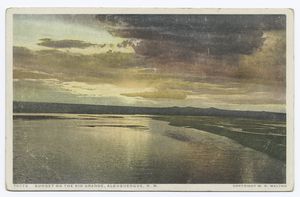
Click image to enlarge.
A fascinating collection of early 20th century Albuquerque postcards from the New York Public Library Digital Gallery. Thanks to a guest blogger at Duke City Fix for the search and link.
Click image to enlarge.
… was proclaimed as such on this date in 1933. This from the National Park Service:
A huge natural amphitheater has been eroded out of the variegated Pink Cliffs (Claron Formation) near Cedar City, Utah. Millions of years of sedimentation, uplift and erosion have created a deep canyon of rock walls, fins, spires and columns, that spans some three miles, and is over 2,000 feet deep. The rim of the canyon is over 10,000 feet above sea level, and is forested with islands of Englemann spruce, subalpine fir and aspen; separated by broad meadows of brilliant summertime wild flowers.
The average price for a gallon of regular gasoline nationwide was “only” up one cent over the weekend according to AAA. That puts it at $2.614. Extra averages $2.774 and premium $2.875. Premium is averaging over $3 in California, Hawaii and Illinois.
I can remember buying a dollar’s worth — and someone else pumped it.
Peter Maass had an informative article in Sunday’s New York Times Magazine — The Breaking Point. A few observations and factoids excerpted from Maass:
• Unlike the 1973 crisis, when the embargo by the Arab members of the Organization of Petroleum Exporting Countries created an artificial shortfall, today’s shortage, or near-shortage, is real. If demand surges even more, or if a producer goes offline because of unrest or terrorism, there may suddenly not be enough oil to go around.
• The consequences of an actual shortfall of supply would be immense. If consumption begins to exceed production by even a small amount, the price of a barrel of oil could soar to triple-digit levels. This, in turn, could bring on a global recession, a result of exorbitant prices for transport fuels and for products that rely on petrochemicals — which is to say, almost every product on the market. The impact on the American way of life would be profound: cars cannot be propelled by roof-borne windmills. The suburban and exurban lifestyles, hinged to two-car families and constant trips to work, school and Wal-Mart, might become unaffordable or, if gas rationing is imposed, impossible.
• The eventual and painful shift to different sources of energy — the start of the post-oil age — does not begin when the last drop of oil is sucked from under the Arabian desert. It begins when producers are unable to continue increasing their output to meet rising demand. Crunch time comes long before the last drop.
• “The problem is that you go from 79 million barrels a day in 2002 to 82.5 in 2003 to 84.5 in 2004. You’re leaping by two million to three million a year, and if you have to cover declines, that’s another four to five million.” In other words, if demand and depletion patterns continue, every year the world will need to open enough fields or wells to pump an additional six to eight million barrels a day — at least two million new barrels a day to meet the rising demand and at least four million to compensate for the declining production of existing fields. “That’s like a whole new Saudi Arabia every couple of years,” Husseini said. “It can’t be done indefinitely. It’s not sustainable.”
It’s an interesting article that, while fearing the worst, does a lot to explain both sides; that is, that there’s plenty of oil or that we’ll be freezing in the dark soon.
From America’s Finest News Source — Evangelical Scientists Refute Gravity With New ‘Intelligent Falling’ Theory.
KANSAS CITY, KS—As the debate over the teaching of evolution in public schools continues, a new controversy over the science curriculum arose Monday in this embattled Midwestern state. Scientists from the Evangelical Center For Faith-Based Reasoning are now asserting that the long-held “theory of gravity” is flawed, and they have responded to it with a new theory of Intelligent Falling.
“Things fall not because they are acted upon by some gravitational force, but because a higher intelligence, ‘God’ if you will, is pushing them down,” said Gabriel Burdett, who holds degrees in education, applied Scripture, and physics from Oral Roberts University.
There’s more.
Good background from Christopher Hitchens in the beginning of his New York Times review of three new non-ficition works on America’s Pirate Wars:
Viewed from our hyperpower perspective, the decades between the Revolutionary War and the War of 1812 were so precarious they seem to belong almost to the history of another country. And in many ways they do. The ”United States” at that time was to the east coast of North America what Chile now is to the west coast of the southern cone: a long and ribbonlike territory with indistinct or disputed frontiers, caught between mountains and the ocean. Three large European empires — British, French and Spanish — exerted immense influence on the rest of the continent, and on the Atlantic and Caribbean approaches to it. The new Republic had a tenuous and fluctuating relationship with France, a hostile one with Britain and a competitive one with Spain. It had no army or navy to speak of, and a Constitution that was skeptical about, if not antagonistic to, the maintenance of permanent armed forces. The two human symbols of this vulnerability were the American sailor seized from his ship and ”impressed” into the British or French Navy, and the sailor or passenger taken at sea by marauding Muslim pirates and delivered into slavery.
Each of three new books treats a different aspect of that vertiginous period. The word ”corsair,” which can mean either pirate ship or pirate, became inextricably and incorrectly linked with the Romantic as a result of Byron’s 1814 poem of that name. But corsairs ruthlessly kidnapped and plundered, whether in Africa (the Barbary Coast) or the Gulf of Mexico. We may still harbor a slight sympathy for the smuggler and the bootlegger, but there was little romance in living at a time when such people had state power.
A couple of items from this morning’s Sideline Chatter in The Seattle Times:
- The police box score from this year’s annual Sturgis Motorcycle Rally in South Dakota reads 388 arrests — 188 for drunken driving, 162 for drug misdemeanors and 38 for drug felonies — and 1,250 citations, AP reported.
“In other words,” wrote Randy Turner of the Winnipeg Free Press, “it’s like a Portland Trail Blazers season, only with Harley Davidsons.”
- Ted Wyman of the Winnipeg Sun, on Rafael Palmeiro’s dwindling credibility: “Right about now, Raffy could tell us Roger Clemens has a good fastball, Alex Rodriguez can hit for power and the outfield grass is green — and we’d have to go for a second opinion.”
The United Farm Workers of America (UFW) was formed on this date in 1966, initially as the United Farm Workers Organizing Committee. The Library of Congress’ Today in History has background, including this:
Through a series of dramatic moves, the UFW brought these issues to the public’s attention. In 1967, one of the first major actions taken by the UFW was to call for a boycott of table grapes, which became a nationwide boycott by 1968.
Several other boycotts against lettuce and strawberry growers were organized in following years. On February 14, 1968, UFW President Cesar Chavez began the first of many fasts in protest of the treatment of farm workers. During this first fast he received a strong letter of support from Martin Luther King Jr. …
In 1969, the UFW organized a march through the Coachella and Imperial Valleys in Central California to the United States-Mexico border to protest growers’ use of illegal immigrants as strike breakers. … In 1970, Chavez was jailed for defying a court injunction against boycotting. While imprisoned, he was visited by Coretta Scott King and Ethel Kennedy.
Through these dramatic moves the UFW won many important benefits for agricultural workers. It brought comprehensive health benefits for farm workers and their families, rest periods, clean drinking water, sanitary facilities, even profit sharing and parental leave. The UFW has also pioneered the fight to protect farm workers against harmful pesticides.
“[D]o you realize that three of the six Democratic presidential candidates as of the New Hampshire primary in 2004 were from states that border New Hampshire? This ridiculous institutional bias in favor of New England has got to go ….”
Colorado Luis in an excellent discussion on “Democrats and the West.”
The Writer’s Almanac has an excellent item on the Lincoln-Douglas debates. It begins:
It was on this day in 1858, that Stephen A. Douglas and Abraham Lincoln began a series of seven debates during the Senate campaign [in] … Illinois. At the time, the country was deeply divided over the expansion of slavery into the … territories, and the debates were covered by newspapers as a kind of microcosm of the national debate. One Washington D.C. newspaper said, “The battle of the Union is to be fought in Illinois.”
Stephen A. Douglas was the incumbent Senator and a nationally known spokesman for the Democratic Party, which supported expansion of slavery. Abraham Lincoln was a former … Congressman who was running for Senate as the member of the brand new Republican Party, which opposed slavery expansion. Lincoln had made a name for himself in a speech that June, when he argued that the country’s crisis would only grow worse until all the states came together in agreement about slavery. He famously said, “A house divided against itself cannot stand.”
Each debate between the two men lasted three hours. The opening speaker addressed the crowd for 60 minutes, without notes. Then his rival offered a 90-minute reply, and finally the opening speaker returned for a 30-minute rebuttal.
Continue reading about the debates from The Writer’s Almanac or, better yet, listen to Garrison Keillor by clicking here [Real Audio].
Douglas won the election.
NewMexiKen realizes that I’m now at an awkward age for golf. My 60-year-old body still occasionally lets me hit the ball farther than my 60-year-old eyes can follow.
Hawaii entered the Union as the 50th state on this date in 1959. The eight major islands in the chain are Ni’ihau, Kaua’i, O’ahu, Moloka’i, Lana’i, Kaho’olawe, Maui and Hawai’i.
Kenny Rogers is 67.
Patty McCormack is 60. The actress, known now as Patricia McCormack, was nominated for the supporting actress Oscar as an 11-year-old for her performance in The Bad Seed.
Kim Cattrall of Sex in the City is 49.
William “Count” Basie was born on this date in 1904.
Count Basie was a leading figure of the swing era in jazz and, alongside Duke Ellington, an outstanding representative of big band style.
Quotation from the PBS website for Jazz: A Film by Ken Burns. The page has a nice biography of Basie with some audio clips, including Basie’s 1937 recording of “One O’Clock Jump,” one of NPR’s 100 “most important American musical works of the 20th century.”
The Newest Indians by Jack Hitt in The New York Times Magazine touches on those who’ve recently discovered their Indian blood and the reaction in Indian country, as well as the concept of ethnicity in America. An excerpt:
How much easier (though scarier) life might be if we all got ethnic identification cards so that when encountering a very light-skinned person claiming to be black, you could reply, ”O.K., show me your federal identification card guaranteeing the proper amount of African blood to qualify you as an African-American.” Here’s the thing: you could ask an Indian that question. Some Native Americans carry what is called, awkwardly, a white card, officially known as a C.D.I.B., a Certificate of Degree of Indian Blood. This card certifies a Native American’s ”blood quantum” and can be issued only after a tribe has been cleared by a federal subagency.
The practice of measuring Indian blood dates to the period just after the Civil War when the American government decided to shift its genocide policy against the Indians from elimination at gunpoint to the gentler idea of breeding them out of existence. It wasn’t a new plan. Regarding Indians, Thomas Jefferson wrote that ”the ultimate point of rest and happiness for them is to let our settlements and theirs meet and blend together, to intermix, and become one people.” When this idea was pursued bureaucratically under President Ulysses S. Grant, Americans were introduced to such phrases as ”half breed” and ”full blood” as scientific terms. In a diabolical stroke, the government granted more rewards and privileges the less Indian you were. For instance, when reservation lands were being broken up into individual land grants, full-blooded Indians were ruled ”incompetent” because they didn’t have enough civilized blood in them and their lands were administered for them by proxy agents. On the other hand, the land was given outright to Indians who were half white or three-quarters white. Here was the long-term catch: as Indians married among whites and gained more privileges, their blood fraction would get smaller, so that in time Indians would reproduce themselves out of existence.
One of the attractions of moving to WordPress has been easier access to NewMexiKen’s statistics. For example, these are the search strings bringing vistors here during the past few hours:
tiger woods’s alma mater
omarosa, birthdate
omarosa nude
jackie gleason
Tiger Woods’s alma mater
American Indian political or artist/cultural issues
blog julia roberts
popcorn article ny times august 19th, 2005
resell value on indian ford
lyrics to prison wisdom by cuban link
Tiger Woods’s alma mater
wovoka
disney-iwerks drawings
put me in coach by Creedence Clearwater Revival
cheeseburger in waikiki
omarosa naked
DATE OF BIRTH JESSICA CANSECO
“eagle feathers” “stored in”
lisa wells voluptuous
Las Vegas 29th in 2004 Population Estimates
songs about Henry Knox
harold bloom and cormac mccarthy and toni morrison
is there a place named after neil alden armstrong
losing “147 pounds”
Saint-Exup
fred wehba
omarosa
chip douglas
Robert Redford+New Mexico
1979 gasoline prices
used wedding dress
omarosa playboy
NINA VON STAUFFENBERG
famous couple blogs
“william and Mary Indians
Tiger went to Stanford. And will Omarosa ever go away?
At Slate, C. Josh Donlan suggests we “rewild” America. He begins:
As the first Americans strolled onto their open real estate 13,000 years ago, at the end of the Pleistocene epoch, their continent quickly lost much of its grandeur. More than 60 North American species weighing over 100 pounds went extinct, including the continent’s own elephants, lions, camels, and cheetahs. The cause was likely overhunting; the result was elephants trotting in the circus ring rather than roaming the land. Meanwhile, most of the Earth’s remaining large wild animals in Africa and Asia are threatened with extinction in the coming century.
“Rewilding”—bringing elephants, cheetahs, and lions out of captivity to run free in parts of North America—could help save these megafauna from global extinction. More important, it would restore to the continent biological functions lost millenniums ago. The big guys would help stop the march of the pests and weeds—rats and dandelions—that will otherwise take over the landscape. And they would promote the natural processes that generate biodiversity. For example, for more than 4 million years before its extinction, the American cheetah preyed on the deerlike pronghorn, a relationship that helped engender the pronghorn’s astonishing speed.
My god, people go crazy now when some poor bear wanders down from the mountains. Can you imagine the reaction to an elephant?
NewMexiKen’s list of the top ten reasons to chose another restaurant if you want to impress your date or customer:
10. You pay before you eat
9. You pay after you eat, but you stand in line and pay a cashier
8. More men eating with caps/hats on than those without caps/hats
7. The piped-in-music is louder than the TVs
6. Soup served with soup spoon already in soup
5. They fill the condiments while you’re at the table
4. Menu includes photos of the food
3. Menu includes samples of the food stuck to pages
2. They wipe your table with a wet rag
And the number one reason to chose another restaurant if you want to impress your date or customer
They wipe the seats of the chairs with the same rag
(First posted a year ago.)
… when they mention the price of a barrel of oil? Here from the New York Mercantile Exchange is a description:
Crude oil is the world’s most actively traded commodity, and the NYMEX Division light, sweet crude oil futures contract is the world’s most liquid forum for crude oil trading, as well as the world’s largest-volume futures contract trading on a physical commodity. Because of its excellent liquidity and price transparency, the contract is used as a principal international pricing benchmark. …
The contract trades in units of 1,000 barrels, and the delivery point is Cushing, Oklahoma, which is also accessible to the international spot markets via pipelines. The contract provides for delivery of several grades of domestic and internationally traded foreign crudes, and serves the diverse needs of the physical market.
Light, sweet crudes are preferred by refiners because of their low sulfur content and relatively high yields of high-value products such as gasoline, diesel fuel, heating oil, and jet fuel.
NewMexiKen thought this paragraph was interesting as well.
The Exchange also lists for trading electronically a financially settled futures contract for Dubai crude oil; a futures contract on the differential between the light, sweet crude oil futures contract and Canadian Bow River crude at Hardisty, Alberta; and futures contracts on the differentials of the light, sweet crude oil futures contract and four domestic grades of crude oil: Light Louisiana Sweet, West Texas Intermediate-Midland, West Texas Sour, and Mars Blend.
Mars Blend? Is that the planet Mars or, with all that sweet talk, the candy company Mars?
Closing price Friday for September delivery of 55 gallons of light, sweet crude: $65.35.
NewMexiKen took the The Week Quiz and guessed at eight of the answers (in other words, I knew just two of the ten). And five of my guesses were right!

Photo courtesy Tech Gadgets Blog – LiewCF.com
Spent shells litter the ground at what is left of the firing range, and camouflage outfits still hang in a storeroom. Just a few months ago, this ranch was known as Camp Thunderbird, the headquarters of a paramilitary group that promised to use force to keep illegal immigrants from sneaking across the border with Mexico.
Now, in a turnabout, the 70-acre property about two miles from the border is being given to two immigrants whom the group caught trying to enter the United States illegally.
The land transfer is being made to satisfy judgments in a lawsuit in which the immigrants had said that Casey Nethercott, the owner of the ranch and a former leader of the vigilante group Ranch Rescue, had harmed them.
From The New York Times
Encouraged by the NCAA’s crackdown on Native American-themed sports teams, People for the Ethical Treatment of Animals has launched a campaign against the “Gamecocks” of Jacksonville State and the University of South Carolina. “Our problem with “Gamecocks” is it promotes cockfighting,” said PETA’s Dan Shannon. “With the NCAA decision about Native American nicknames, we hope that might spur them on—no pun intended—to adopt a nickname more respectful to animals.”
Next:
If a 59-year-old Speegleville man had not been arrested Monday night shortly after he reportedly destroyed a roadside memorial to fallen U.S. soldiers near President Bush’s ranch, McLennan County Sheriff Larry Lynch would have known where to find him later this week — in Lynch’s Sunday School class.
Sheriff’s office investigators said Larry Chad Northern drove his pickup truck over hundreds of small wooden crosses bearing the names of soldiers who died in the war that peace activists had placed along Prairie Chapel Road. …
Northern was arrested shortly after 9:30 p.m. Monday after he was spotted changing a tire on his pickup, authorities said. Small white crosses were found stuck in the truck’s undercarriage, according to sheriff’s office reports.
From the Waco Tribune-Herald. Northern is a Vietnam veteran.
Functional Ambivalent has some interesting observations on the war protest at Crawford and President Bush’s reaction — Necessary Inhumanity.
“I went to fill up this morning and there was a sign on the pump, ‘We take Visa, Master Card, American Express.’ So they took my Visa, Mastercard and my American Express!”
Jay Leno (August 10)
VAIL, Arizona — Students at Empire High School here started class this year with no textbooks — but it wasn’t because of a funding crisis. Instead, the school issued iBooks — laptop computers by Apple Computer — to each of its 340 students, becoming one of the first U.S. public schools to shun printed textbooks.
School officials believe the electronic materials will get students more engaged in learning. Empire High, which opened for the first time this year, was designed specifically to have a textbook-free environment.
From the AP via Wired News. Vail is a suburb of Tucson.
William Jefferson Clinton is 59 today.
From a report in Friday’s New York Times — M.R.I. Scanners’ Strong Magnets Are Cited in a Rash of Accidents:
The pictures and stories are the stuff of slapstick: wheelchairs, gurneys and even floor polishers jammed deep inside M.R.I. scanners whose powerful magnets grabbed them from the hands of careless hospital workers.
The police officer whose pistol flew out of his holster and shot a wall as it hit the magnet. The sprinkler repairman whose acetylene tank was yanked inside, breaking its valve and starting a fire that razed the building.
But the bigger picture is anything but funny, medical safety experts say. As the number of magnetic resonance imaging scanners in the country has soared from a handful in 1980 to about 10,000 today, and as magnets have quadrupled in power, careless accidents have become more frequent. Some have caused serious injuries and even death.
…
The most notorious accident was the death of 6-year-old Michael Colombini in 2001 at the Westchester Medical Center in Valhalla, N.Y. He was sedated in a scanner after a brain operation when his oxygen supply failed. An anesthesiologist ran for an oxygen tank and failed to notice that the one he found in the hall outside was made of steel. As he returned, the tank shot out of his hands, hitting Michael in the head.