“How does CNN expect to be taken seriously when they’re running on a ‘report first, ask later’ strategy?”
Category: Media & Journalism
My Thoughts, Exactly
“I hate, hate, hate television news. Hate it. I stopped watching it entirely after 9/11 and hadn’t turned it back on for more than a year after that for any reason. Even now it makes me frustrated and angry and annoyed, even just in the short doses I get when I’m passing through an airport or whatever. I think it’s generally irresponsible and destructive to society.”
A publisher who gets it line of the day
“A year or so we took the word ‘publications’ off the building and took it off of our business cards. There was this final commitment to the fact that we are a company that makes quality content…and we’re going to put that on whatever medium it makes sense.”
Drew Schutte, chief integration officer at Condé Nast, via Nieman Journalism Lab
75 years ago the railroads thought they were in the railroad business when they needed to see they were in the transportation business. There were 132 Class I railroad companies in 1939; there are now seven.
Publishers like Condé Nast finally seem to be realizing they are in the content business not the newspaper or magazine business.
My Favorite Metaphor
Dean Baker refers to The Washington Post as “Fox on 15th Street.”
Best line of the day following up on an earlier NMK post
“I know that, at this point, ripping on the WaPo because of the quality of its opinion pieces (George Effing Will included or not) is the functional equivalent of criticizing the way that a goat sings opera . . .
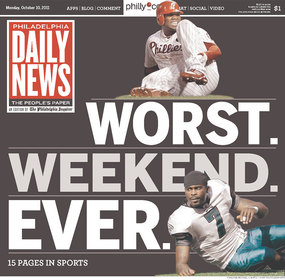
Front Page of the Day

Best lines of the day about George Will
Is there a more unmitigated horse’s ass in American public life than George Effing Will?
Is there a more breathtaking coupling of tinhorn erudition and pig-ignorant arrogance? Is there anyone who is a more perfect combination of tea-cosy courage, sherry-sipping macho, and lace-hanky contempt for everyone who isn’t himself? Is there another human being on this planet who more richly deserves to be hung from a coat rack by his undershorts? Is there a dumber looking bow-tie? Breathes there a man with a soul so dead? These are our questions.
Top Ten American Newspaper Columns Ever
DETROIT, Saturday, June 25, 2011 – In a survey of columnists nationwide, the top American column in history was typed up by the late, great Ernie Pyle.
Pyle’s “The Death of Captain Waskow” first was published Jan. 10, 1944, by his syndicate, Scripps Howard.
Background from National Society of Newspaper Columnists.
15 columns were nominated and can be read in a 31-page free pdf download.
Today’s ‘Best’ Front Page

The story begins:
She-devil. Witch. Dominatrix. Venus in furs. Rarely can a defendant have been subjected to such an unbridled courtroom character assassination as Amanda Knox, a siren who could apparently entice a virtual stranger to commit murder with her hypnotic sexual charms.
Amazing factoid of the day
“Facebook, with about $2 billion in digital ad revenues this year, will be two-thirds of the way to equaling the total digital ad revenue — about $3 billion — of the entire U.S. newspaper industry.”
Today’s Front Pages
Today’s Top Ten Front Pages are worth a click. One day link only.
Pumpkins
“Welcome to the first day of fall,” proclaims The Journal of Seneca, S.C. Since nothing says fall like pumpkins, we present an all pumpkin edition of the Top Ten. But even these colorful pictures come with a news hook — we may be seeing less of the popular gourd this fall because of this summer’s weird weather.
Link good Friday only.
Albuquerque Journal
The Albuquerque Journal has launched an iPad/iPhone/iPod Touch app that makes a replica of the newspaper available daily. The app is free and for the rest of September you can download the daily edition free too.
What will be interesting is whether the Journal will make electronic subscriptions available at a reasonable price without requiring a subscription to the printed version as has been the case. By reasonable I’m thinking something like the San Francisco Chronicle‘s $5.99/month, $59.99/year.
Personally I don’t care much for most newspaper websites, though their content is often superb. I find the homepages inordinately cluttered, as if in printed version parlance they were trying to get the whole newspaper onto the front page. Various apps generally are much better at presenting digestible portions. For example, I think the best way to see what’s in The New York Times is the Times Skimmer.
The internet has proven an insurmountable challenge for most newspapers. Not only do they still — necessarily — rely on the printed edition for most of their revenue, but — and I think this has been the bigger underlying problem — there is no longer much need for their amalgamation of news, sports, comics, features, weather, gossip, advice to the lovelorn, photos, TV listings, movie reviews, etc. We can find all that and more in great detail with just a few clicks. Perhaps newspapers should have honed their uniqueness — local news and local sports — and foregone the rest. I don’t know.
Best line of the day
“Miss Larry King. He would’ve had Jermaine Jackson, Ryan Seacrest and Cher on tonight to talk about Libya and the quake.”
BTW, this post is somewhat of a milestone.
 |
|
(That’s an average of 6.8 a day for eight years and 20 days.) |
Best line of the day
“I walked in to my office from our evacuation to see this chyron on CNN:
“5.9 EARTHQUAKE HITS VIRGINIA
Disrupts Strauss-Kahn Press Conference”
All I can say is thank goodness Kim Kardashian wasn’t hurt.
Today’s Post Redux
First posted here eight years ago today.
In A Viewer’s Companion to ‘Citizen Kane’ Roger Ebert says his favorite speech in Kane is delivered by Mr. Bernstein (Everett Sloane) when he is talking about the magic of memory with the inquiring reporter:
A fellow will remember a lot of things you wouldn’t think he’d remember. You take me. One day, back in 1896, I was crossing over to Jersey on the ferry, and as we pulled out, there was another ferry pulling in, and on it there was a girl waiting to get off. A white dress she had on. She was carrying a white parasol. I only saw her for one second. She didn’t see me at all, but I’ll bet a month hasn’t gone by since, that I haven’t thought of that girl.
‘This ain’t a football game. We do this every day.’
Gene Lyons wishes politics was baseball, and makes this observation:
Business correspondent Ali Velshi struggled to explain the basics to the excited anchorman. Investors cashing out of stocks were buying U.S. Treasury bills. Bond yields were dropping — precisely the opposite effect S&P’s grandstanding would have caused if markets took it seriously.
Short of dousing Blitzer with a fire extinguisher, there seemed no way to make him understand. Actually, I expect he wasn’t confused, but performing. Cable news channels hype Washington melodrama to boost ratings. Absent real crises, they invent them. Broadly speaking, Republican operatives understand this; Democrats not so much.
. . .
Now a baseball announcer who didn’t grasp the infield fly rule, or pretended that the Yankees batting order affected their earned run average would be out of work. Fans demand competence. Sports journalists have their faults, but they do have to get the scores right.
The Cult That Is Destroying America
“The reality, of course, is that we already have a centrist president — actually a moderate conservative president. Once again, health reform — his only major change to government — was modeled on Republican plans, indeed plans coming from the Heritage Foundation. And everything else — including the wrongheaded emphasis on austerity in the face of high unemployment — is according to the conservative playbook.”
His “Cult That Is Destroying America”?
News organizations and pundits. Go read.
Dead tree update
I cancelled the home delivery of The New York Times after an 8-week experiment. No going back; it was more nuisance than anything else.
And this from someone who before coming to Albuquerque had a daily paper delivered most of my life.
Best line of the day
“It is irresponsible to run a story with a statement from one politician saying it is sunny and warm in Alaska and another saying that actually the temperature is below zero and it’s snowing. There are real conditions in Alaska that the reporter should know and be able to tell readers. This information will let readers know that one politician is being largely truthful, while one is not. Reporters who have a job reporting the news have the time to find out about the actual weather conditions in Alaska. Readers generally do not.”
Things are really screwed up line of the day
“Today is Katie Couric’s last day as anchor of the CBS Evening News. Couric received $15 million dollars for each of the five years she held the coveted position. As Michael Massing at the Columbia Journalism Review calculated, this number is more than the combined amount NPR spends each year on its two biggest shows, Morning Edition and All Things Considered.”
Today’s Times
NewMexiKen subscribes to The New York Times — yes, beginning again this week to the actual dead-tree version. Anyway, as those of you who don’t subscribe (print or digital) may know, you only get 20 free articles a month. So, borrowing an idea from The Atlantic Wire, I’ll feature articles that I think are worth spending your allowance on.
Here’s two very different stories, which I think describe people and how they react to very real, yet very different kinds of crises. Neither story is particularly long, and both I thought were good reads.
A Town’s Few Holdouts Wait Out the Flood at the Bar
In Misurata, Qaddafi’s Soldiers Receive Respect, if Not Honors
Best line of the day
“There are many ways to have a good day in the magazine business as it gets stranger and stranger. Ours today at The New Yorker is to see our app has passed Angry Birds in the iTunes store. Eat your heart out, William Shawn.”
New Yorker editor David Remnick quoted at Poynter
The left is right
“A Hamilton College class and their public policy professor analyzed the predicts of 26 pundits — including Sunday morning TV talkers — and used a scale of 1 to 5 to rate their accuracy. After Paul Krugman, the most accurate pundits were Maureen Dowd, former Pennsylvania Governor Ed Rendell, U.S. Senator Chuck Schumer (D-NY), and former House Speaker Nancy Pelosi. ‘The Bad’ list includes Thomas Friedman, Clarence Page, and Bob Herbert.”
News that tells you nothing
It is difficult to understand why newspaper editors think that their typical readers have more time to evaluate the truth of politicians’ claims [than] reporters who have a full time job to do such things. However [this] seems to be a widely held view, since so often articles are devoted to telling us what the politicians claim without including any effort to uncover what is true.
Today’s he said/she said in the Post and the NYT is about high gas prices. The Democrats are looking to take back tax breaks from the oil industry while the Republicans are pushing to “drill here, drill now.” It would have been useful to include a bit of analysis so that readers could judge the likely impacts of the two policies.
Dean Baker at Beat the Press goes on to provide the analysis, as he often does.